Industrial Pharma Drying Equipment Supplier in Bhiwandi

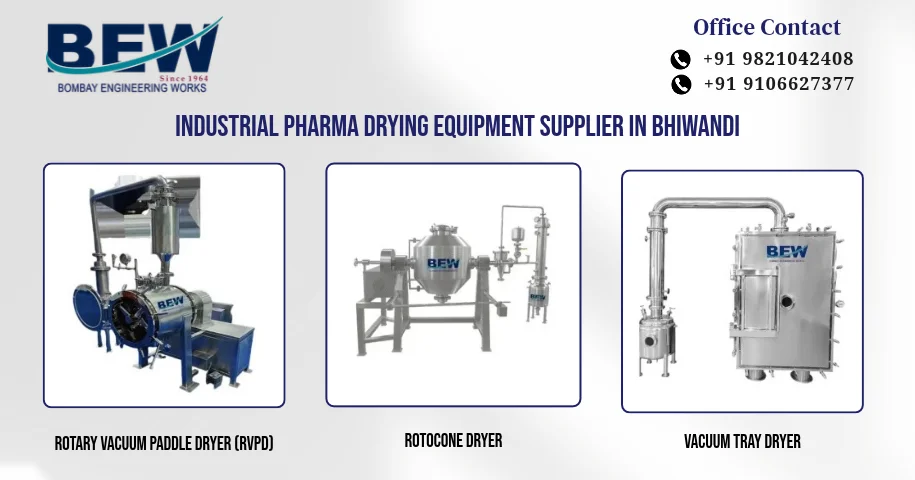




Industrial Pharma Drying Equipment Supplier in Bhiwandi | Bombay Engineering Works
If you are searching for an Industrial Pharma Drying Equipment Supplier in Bhiwandi, Bombay Engineering Works offers industrial machinery solutions backed by a manufacturing legacy established in 1964. The company manufactures and supplies a wide range of pharmaceutical machinery, chemical machinery, food processing machinery, cosmetic machinery, and Ayurvedic and herbal machinery. Its product portfolio includes fluid bed dryers and other industrial drying equipment for different processing applications.
Bombay Engineering Works helps businesses explore industrial machinery options based on their operational requirements. Whether you are establishing a new pharmaceutical production unit, expanding an existing facility, or upgrading your drying process, understanding the available equipment options can help you make a more informed purchasing decision.
Call us today: 9821042408 Website: www.bombayengg.com
About Bombay Engineering Works
Bombay Engineering Works was established in 1964 and manufactures a wide range of industrial machinery for pharmaceutical, chemical, food processing, cosmetic, Ayurvedic, and herbal industries. Its product portfolio includes drying equipment and other processing machinery for industrial applications.
With decades of manufacturing experience, the company serves businesses seeking machinery suited to their production requirements. Its equipment portfolio supports different processing needs, with selection depending on product characteristics, capacity, and operating conditions.
What Is Industrial Pharmaceutical Drying Equipment?
Industrial pharmaceutical drying equipment is machinery designed to remove moisture or other volatile substances from pharmaceutical materials under controlled processing conditions. Depending on the product and manufacturing stage, these systems may use heated air, vacuum, indirect heating, or a combination of process mechanisms.
Drying is commonly required after granulation, filtration, washing, extraction, or other manufacturing operations. The objective is to achieve a specified moisture level while preserving the required physical and chemical characteristics of the material.
For example, pharmaceutical granules may need drying before tablet compression. Certain heat-sensitive materials may require lower-temperature processing, while other products may benefit from controlled air circulation and agitation.
A suitable drying system can help manufacturers achieve:
- Consistent moisture removal across a batch.
- Better control over processing conditions.
- Improved suitability of materials for downstream operations.
- Reduced risk of excessive heating when the process is properly designed.
- More predictable production scheduling.
- Easier integration with existing manufacturing equipment.
- Better documentation and process repeatability when appropriate controls are provided.
Nevertheless, drying performance depends on several variables, including the starting moisture content, product composition, particle size, loading depth, airflow, temperature, and drying time. Consequently, equipment selection should be based on the actual application rather than a general assumption that one dryer will suit every pharmaceutical product.
Why Choose an Industrial Pharma Drying Equipment Supplier in Bhiwandi?
When pharmaceutical companies search for an industrial pharma drying equipment supplier in Bhiwandi, they generally need equipment that meets their production requirements without creating unnecessary operational complexity.
A suitable supplier should understand the intended application, explain the available machinery options, provide relevant technical information, and help the buyer assess the suitability of the proposed equipment.
1. Equipment Selection Based on Process Requirements
Different pharmaceutical materials respond differently to heat, airflow, vacuum, and mechanical movement. A dryer that performs well with one type of granule may not be the most appropriate solution for a sticky, solvent-containing, or heat-sensitive material.
2. Support for Production Planning
Drying can become a production bottleneck if the selected equipment cannot handle the required batch volume or processing time. Evaluating equipment capacity alongside actual cycle times helps manufacturers plan production more realistically.
3. Integration With Existing Machinery
Pharmaceutical production lines often include granulators, blenders, milling equipment, sifters, tablet presses, and packaging systems. Drying equipment must fit logically within the manufacturing workflow.
4. Long-Term Operating Considerations
The purchase price is only one part of the total cost of ownership. Electricity or steam consumption, maintenance, replacement parts, cleaning time, operator training, and production downtime can also affect the overall investment.
5. Access to Technical Information
Before placing an order, buyers should request relevant technical specifications, equipment drawings, utility requirements, construction materials, control-system details, and information about cleaning and maintenance.
Types of Industrial Pharmaceutical Drying Equipment
Pharmaceutical drying systems differ in their operating principles, product-handling methods, and suitable applications. The following equipment categories are worth evaluating when selecting a drying solution for a pharmaceutical facility in Bhiwandi.
1. Fluid Bed Dryer
A fluid bed dryer is commonly used to dry pharmaceutical granules and powders. It works by passing controlled heated air through a bed of particles, causing them to move and become suspended under suitable operating conditions.
This movement increases contact between the drying air and the material, supporting moisture transfer from the product into the exhaust air.
Fluid bed dryers are widely considered for pharmaceutical granules produced during wet granulation. The drying process can be followed by milling, blending, compression, or other downstream operations, depending on the manufacturing process.
Important features to evaluate include:
- Product container and contact-part construction.
- Air handling and filtration arrangements.
- Temperature and airflow controls.
- Moisture sampling or monitoring options.
- Dust containment and exhaust arrangements.
- Cleaning access and product discharge.
- Safety provisions appropriate to the material being processed.
A fluid bed dryer may not be suitable for every material. Very cohesive powders, highly sticky products, or materials with special handling requirements may need alternative equipment or additional process evaluation.
2. Tray Dryer
A tray dryer is an industrial drying system in which material is spread across trays and dried using heated air circulated through the drying chamber.
It is a familiar option for batch-processing operations and can be considered for suitable pharmaceutical, chemical, food, and herbal materials.
The product is placed in trays, loaded into the chamber, and exposed to controlled drying conditions for the required period. After drying, the material is removed for the next manufacturing stage.
Before purchasing a tray dryer, buyers should examine:
- Number and dimensions of trays.
- Usable loading area.
- Air circulation and temperature uniformity.
- Heating arrangement and energy source.
- Chamber construction and insulation.
- Cleaning and maintenance accessibility.
- Batch capacity and expected cycle duration.
Tray dryers should be assessed through application-specific testing where necessary, especially when the product is sensitive to temperature or requires tightly controlled residual moisture.
3. Vacuum Tray Dryer
A vacuum tray dryer removes moisture under reduced pressure. Lower pressure can reduce the temperature at which moisture evaporates, making vacuum drying worth considering for selected heat-sensitive materials.
In a typical process, the product is distributed across trays inside a vacuum chamber. Heat is supplied through the designed heating arrangement, and moisture vapour is removed using a vacuum system.
Potential applications include selected pharmaceutical intermediates, chemical compounds, extracts, and other materials that are compatible with the system’s operating conditions.
The term “vacuum dryer” covers multiple equipment configurations. Buyers should confirm whether a tray-based, rotary, paddle, or other vacuum drying design is appropriate for their product rather than assuming all vacuum dryers operate in the same way.
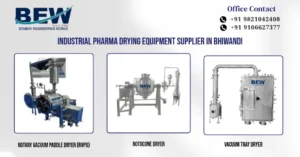
4. Rotary Vacuum Paddle Dryer
A rotary vacuum paddle dryer uses mechanical agitation and an appropriate heating arrangement to support drying within a closed vessel under reduced pressure.
The paddles move the material and help expose different portions of the product to the drying surfaces. This design may be considered for selected powders, pastes, wet solids, and materials that are difficult to dry using conventional methods.
Depending on the design and application, a rotary vacuum paddle dryer may be useful where controlled drying, enclosed handling, or reduced-pressure processing is required.
Buyers should evaluate the following before selecting this equipment:
- Vessel and contact-part materials.
- Heating surface and heat-transfer arrangement.
- Agitator design and operating speed.
- Vacuum system and vapour collection.
- Product discharge mechanism.
- Cleaning and inspection requirements.
- Process safety and solvent-handling provisions.
5. Membrane Filtration Systems
Some manufacturing processes require equipment with particular capabilities, such as low-temperature drying, enclosed material handling, specialised solvent recovery, or continuous processing.
Depending on the application, manufacturers may evaluate other dryer configurations, including vacuum conical dryers, rotary dryers, or specialised systems supplied by qualified equipment manufacturers.
These options should not be treated as interchangeable. Each uses a different combination of heat transfer, material movement, pressure conditions, and moisture-removal mechanisms.
The appropriate choice depends on the process specification, product properties, throughput requirements, installation conditions, and applicable safety requirements.
Applications of Industrial Pharma Drying Equipment
Pharmaceutical drying equipment supports several stages of manufacturing. The appropriate system depends on the formulation, process sequence, and required material properties.
Drying Pharmaceutical Granules
Granules produced through wet granulation often require drying before further processing. A suitable dryer helps bring the material to the required moisture range before milling, blending, or compression.
Excessive moisture can affect flow and downstream processing, while insufficiently controlled drying may alter granule properties. The required endpoint must therefore be established for the specific formulation.
Processing Pharmaceutical Powders
Selected pharmaceutical powders require moisture reduction to achieve the required handling, processing, or storage characteristics.
Equipment selection should consider particle size, cohesiveness, dust generation, sensitivity to heat, and the risk of contamination during transfer.
Drying Chemical Intermediates
Chemical manufacturing processes may generate wet solids after filtration, washing, crystallisation, or other operations. Depending on chemical compatibility and process hazards, tray dryers, vacuum dryers, or other suitable systems may be evaluated.
Solvent-containing materials require particular attention to ventilation, vapour management, ignition risks, and equipment suitability.
Processing Herbal and Ayurvedic Materials
Herbal extracts and other botanical materials may require drying before further processing or formulation.
These materials can vary in moisture content, composition, texture, and sensitivity to heat. The drying conditions must be selected to meet the intended product specifications rather than relying on a universal temperature or cycle time.
Supporting Other Pharmaceutical Production Operations
Drying equipment may also be part of a larger manufacturing process involving granulation, blending, milling, coating, or packaging preparation.
Planning the complete process helps reduce unnecessary handling and makes it easier to define the equipment’s capacity, transfer points, cleaning requirements, and documentation needs.
Benefits of Choosing the Right Pharmaceutical Dryer
A properly selected and operated dryer can provide several operational advantages.
Consistent product quality: Controlled drying conditions can help maintain repeatable moisture levels and suitable material characteristics.
Improved process planning: Appropriate batch capacity and realistic drying-cycle expectations support production scheduling.
Better downstream processing: Material dried to its required specification may be easier to handle, mill, blend, or compress, depending on the formulation.
Reduced unnecessary handling: A suitable equipment layout and transfer arrangement can help limit avoidable product movement.
Improved process control: Suitable instrumentation, documented procedures, and defined endpoints support repeatability.
Maintenance planning: Accessible components, clear maintenance instructions, and suitable spare-parts support can help reduce avoidable downtime.
These benefits are not automatic. They depend on correct equipment selection, installation, operation, cleaning, maintenance, and verification of performance.
The Future of Pharmaceutical Drying Equipment
Pharmaceutical manufacturing continues to place emphasis on process consistency, operational efficiency, data integrity, and contamination control. Drying equipment is part of this wider shift toward better-controlled manufacturing.
Improved Process Monitoring
Suitable sensors and control systems can help operators monitor important process variables, such as temperature, pressure, and airflow.
Heating and air handling can account for a meaningful share of a drying system’s operating requirements.
Better Energy Management
The value of monitoring depends on sensor placement, calibration, system configuration, and the way collected information is used.
Energy performance can be evaluated by considering insulation, airflow design, heat losses, operating schedules, and the energy needed to achieve the specified endpoint. Any claimed energy savings should be supported by application-specific evidence.
E-E-A-T: Why Experience Matters in Industrial Machinery
Experience
Established in 1964, Bombay Engineering Works has decades of experience manufacturing industrial processing machinery for various industries.
Expertise
The company specializes in pharmaceutical drying equipment and machinery for chemical, food processing, cosmetic, Ayurvedic, and herbal industries.
Authoritativeness
Its long-standing manufacturing presence and diverse product portfolio demonstrate its industry knowledge and technical capabilities.
Trustworthiness
Bombay Engineering Works focuses on providing industrial machinery solutions suited to different production requirements and operational needs.
Frequently Asked Questions (FAQs)
Q1. Who is an industrial pharma drying equipment supplier in Bhiwandi?
Ans: Bombay Engineering Works is an industrial machinery manufacturer established in 1964 that offers pharmaceutical and related processing equipment. Businesses in Bhiwandi can contact the company to discuss suitable drying equipment and current specifications.
Q2. Which types of pharmaceutical drying equipment are available?
Ans: Common types include fluid bed dryers, tray dryers, vacuum tray dryers, and rotary vacuum paddle dryers. The appropriate equipment depends on product properties, moisture-removal requirements, batch capacity, and process conditions.
Q3. How do I choose the right pharmaceutical dryer?
Ans: Evaluate the product’s initial and target moisture content, heat sensitivity, batch size, drying time, material compatibility, cleaning requirements, safety considerations, and operating costs. Request a technical proposal based on these requirements.
Q4. Is a fluid bed dryer suitable for pharmaceutical granules?
Ans: A fluid bed dryer is commonly used for suitable pharmaceutical granules because controlled heated air passes through the material to support moisture removal. Suitability depends on the granules’ physical properties and the required process conditions.
Q5. When should I consider a vacuum tray dryer?
Ans: A vacuum tray dryer may be appropriate for selected heat-sensitive materials or products that benefit from reduced-pressure drying. The final choice depends on the product’s thermal stability, solvent characteristics, and required moisture endpoint.
Contact Us
Address: Unit No. 9, Unity Industrial Estate, Naikpada, Valiv Village, Near Ganesh Mandir, Vasai East, Dist: Palghar-401208.
Phone: +91 9821042408 / +91 9106627377
Email: info@bombayengg.com / admin@bombayengg.com / support@bombayengg.com
Website: www.bombayengg.com
Conclusion
Choosing the right industrial pharma drying equipment supplier in Bhiwandi requires careful consideration of product characteristics, drying technology, production capacity, process control, cleaning, safety, and long-term operating costs.
Established in 1964, Bombay Engineering Works manufactures a range of industrial machinery for pharmaceutical, chemical, food processing, cosmetic, Ayurvedic, and herbal applications. Businesses can explore its product portfolio and discuss their drying equipment requirements directly with the company.
Call Bombay Engg today: 9821042408
Visit: www.bombayengg.com
“Don’t forget to share this post!”