Pharma Filtration Equipment Supplier in Bhiwandi





Pharma Filtration Equipment Supplier in Bhiwandi | Bombay Engineering Works
The pharmaceutical industry requires precision, cleanliness, and consistency at every stage of production. Choosing a reliable Pharma Filtration Equipment Supplier in Bhiwandi is essential for pharmaceutical manufacturers and industrial businesses that need efficient solid-liquid separation and liquid clarification. Established in 1964, Bombay Engineering Works manufactures and supplies industrial machinery for pharmaceutical, chemical, food processing, cosmetic, Ayurvedic, and herbal industries.
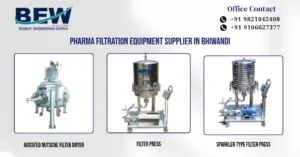
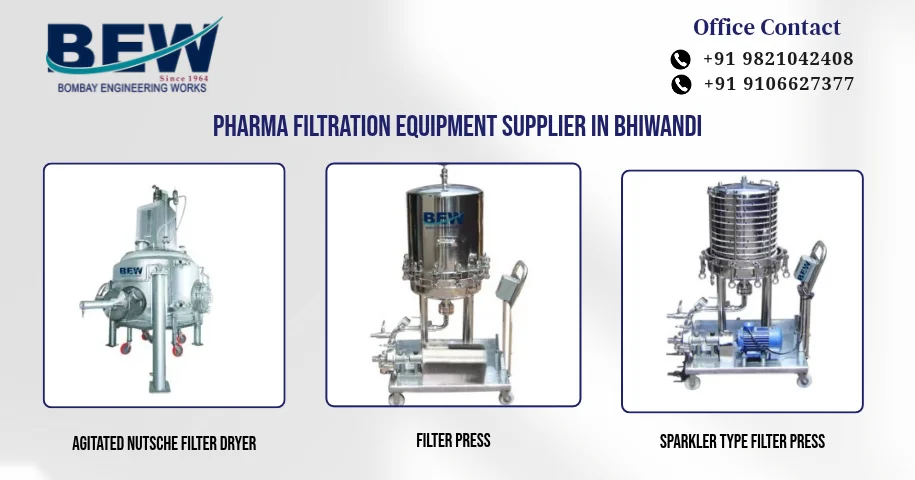
Bombay Engineering Works offers a range of filtration-related machinery, including sparkler-type filter presses, zero hold-up filter presses, and agitated Nutsche filters. Selecting the right equipment depends on the product characteristics, filtration requirements, batch capacity, cleaning procedures, and operating conditions. With decades of engineering experience, the company helps businesses evaluate suitable machinery for their processing needs, operational efficiency, and long-term usability.
Call us today: 9821042408 Website: www.bombayengg.com
About Bombay Engineering Works
Bombay Engineering Works, established in 1964, is a manufacturer and supplier of industrial machinery serving the pharmaceutical, chemical, food processing, cosmetic, and Ayurvedic and herbal industries. The company offers a diverse range of processing equipment for different manufacturing applications.
With decades of industry experience, Bombay Engineering Works focuses on providing machinery suited to industrial processing requirements. Its equipment portfolio includes filtration-related machinery and other solutions designed to support manufacturing operations across multiple sectors.
What Is Pharmaceutical Filtration Equipment?
Pharmaceutical filtration equipment is machinery used to separate suspended particles, solids, or other unwanted materials from liquids, gases, or process streams during pharmaceutical manufacturing. Depending on the application, filtration may be used for clarification, solid-liquid separation, process protection, or microbial retention.
For example, a manufacturer may need to separate crystals from a liquid after a chemical reaction. Another facility may require clarification of a liquid formulation before the next processing stage. In each case, the filtration method must be selected according to the product’s physical and chemical characteristics.
Unlike a general-purpose filtration system, equipment intended for pharmaceutical applications must be evaluated for its suitability for the specific product, cleaning procedure, operating conditions, and quality requirements.
Pharmaceutical filtration machinery may include:
- Sparkler-type filter presses for suitable liquid clarification applications.
- Zero hold-up filter presses for processes where minimising retained liquid is important.
- Agitated Nutsche filters for appropriate solid-liquid separation and related processing operations.
- Cartridge and membrane filtration systems for compatible process requirements.
- Specialised sterile filtration systems when validated microbial retention is necessary.
- Process filtration equipment designed around particular production requirements.
Not every filtration machine performs the same function. A filter press designed for separating suspended solids, for example, should not automatically be considered suitable for sterilising a pharmaceutical liquid.
Why Is Filtration Important in Pharmaceutical Manufacturing?
Filtration contributes to multiple stages of pharmaceutical production. Although its exact purpose varies by product and process, the main objective is to achieve the required separation or removal of unwanted material under controlled conditions.
1. Improving Liquid Clarity
Liquid pharmaceutical preparations and intermediate process liquids may contain suspended particles that need to be removed before further processing.
Suitable clarification equipment helps separate these particles from the liquid. The required clarity depends on the formulation, the next processing stage, and the product’s established quality specifications.
2. Supporting Solid-Liquid Separation
Many pharmaceutical and chemical manufacturing processes produce a mixture of solids and liquids. The solid fraction may be the desired product, or it may represent unwanted material that needs to be removed.
Filtration equipment helps separate these phases, supporting downstream operations such as washing, drying, recovery, and transfer.
3. Supporting Process Consistency
A properly selected filtration system can help manufacturers maintain repeatable operating conditions. However, consistency also depends on the filter medium, process parameters, material characteristics, cleaning procedures, and operator practices.
For this reason, filtration equipment should be assessed as part of the complete manufacturing process rather than as an isolated machine.
4. Protecting Downstream Equipment
Removing suitable particulate material before it reaches a downstream operation may help reduce fouling, blockage, or unnecessary wear.
The effectiveness of this approach depends on particle size, filtration efficiency, the characteristics of the process stream, and the requirements of the equipment being protected.
5. Supporting Documented Quality Systems
Pharmaceutical manufacturing requires suitable equipment, controlled operating procedures, and appropriate records. Filtration machinery should be selected and maintained according to the applicable quality requirements for the intended application.
The equipment itself does not guarantee regulatory compliance. Instead, its design, qualification where required, operation, cleaning, and maintenance must form part of the manufacturer’s quality system.
Types of Pharma Filtration Equipment Available for Industrial Applications
When evaluating a Pharma Filtration Equipment Supplier in Bhiwandi, manufacturers should understand the differences between available filtration technologies. Each design offers particular benefits and limitations.
1. Sparkler-Type Filter Press
A sparkler-type filter press is used for suitable liquid filtration and clarification applications. Depending on its configuration, the system uses filter media supported by a series of plates or discs to retain suspended solids while allowing the liquid to pass through.
The collected solids remain on the filter medium, while the filtered liquid is directed toward the designated outlet.
Common application considerations include:
- Clarification of compatible industrial process liquids.
- Removal of suspended particles from suitable liquid streams.
- Filtration of selected pharmaceutical or chemical intermediates.
- Processes where the required filtration area and filter-medium arrangement can be matched to production needs.
The appropriate design depends on the liquid’s viscosity, solids loading, particle characteristics, operating pressure, temperature, and chemical compatibility.
Before purchasing a sparkler-type filter press, buyers should confirm the intended filtration duty, expected throughput, filtration fineness, cleaning requirements, and compatibility with the process material.
2. Zero Hold-Up Filter Press
A zero hold-up filter press is designed to minimise the quantity of liquid retained within the filtration equipment at the end of an operation.
This feature can be useful when the process involves expensive liquids, valuable intermediates, or materials for which reducing product retention is an operational priority.
Potential considerations include:
- Reducing retained liquid within the equipment.
- Supporting recovery of valuable process material.
- Improving the suitability of equipment for particular batch operations.
- Helping manage product losses where retained volume affects process economics.
The term “zero hold-up” should not be interpreted as a guarantee that absolutely no material remains in every operating condition. Actual retained volume depends on the equipment design, installation, process fluid, filter medium, and operating procedure.
3. Agitated Nutsche Filter
An agitated Nutsche filter is a vessel-based system used for suitable solid-liquid separation applications. Depending on the design, it can support filtration, cake washing, and other operations associated with handling the separated solids.
The agitation mechanism helps manage the material within the vessel. Certain configurations may also support additional process steps, depending on the equipment specification.
Typical evaluation points include:
- The characteristics of the solid material.
- The viscosity and chemical properties of the liquid.
- Required filtration and washing performance.
- Cake handling and discharge arrangements.
- Cleaning accessibility and containment requirements.
- The need for additional process capabilities.
Agitated Nutsche filters are often considered for processes in which controlled handling of the retained solid is important. Nevertheless, the final selection must reflect the actual material properties and process conditions.
4. Cartridge Filtration Systems
Cartridge filters use replaceable filter elements to retain particles from compatible liquids or gases. The available media and filtration ratings vary according to the intended application.
Cartridge filtration may be considered for prefiltration, polishing, utility filtration, or other suitable duties.
However, a cartridge filter used for particulate removal is not automatically appropriate for sterile pharmaceutical processing. Sterilising-grade applications require the correct validated filter, compatible process conditions, and the necessary integrity testing and microbiological controls.
5. Membrane Filtration Systems
Membrane filtration uses a selective membrane to separate materials according to the membrane’s characteristics and the process conditions.
Depending on the technology, membranes may be used for particulate removal, microbial retention, or specialised separation applications.
The selection process should consider membrane compatibility, differential pressure, flow rate, temperature, product interactions, and the required validation evidence.
Where sterile filtration is necessary, the filtration system must be appropriate for the specific product and intended sterility assurance strategy. A conventional industrial filter press cannot be treated as a substitute for a validated sterilising-grade filtration system.
How to Choose the Right Pharmaceutical Filtration Equipment
Selecting suitable filtration equipment requires a clear understanding of the material being processed and the result expected from the filtration step.
Before finalising a purchase, pharmaceutical manufacturers should assess the following factors.
1. Define the Filtration Objective
Start by identifying exactly what the equipment must accomplish.
Is the objective to clarify a liquid, recover a solid, reduce retained product volume, remove particles, wash a filter cake, or achieve validated microbial retention?
These objectives require different technologies. Defining the intended result early helps narrow down suitable options and prevents the purchase of equipment that cannot meet the required process specification.
2. Understand the Product Characteristics
The material being processed has a direct impact on filtration performance.
Important characteristics include:
- Viscosity and density.
- Solid concentration and particle-size distribution.
- Chemical composition and compatibility.
- Temperature and sensitivity to heat.
- Foaming tendency, where relevant.
- Whether the material is hazardous, potent, or sensitive to contamination.
- Whether the product can be recovered, washed, or reused.
A filter that performs effectively with a low-viscosity liquid may behave differently with a thick or highly concentrated suspension.
Therefore, the equipment supplier needs sufficient process information to assess suitability.
3. Select Suitable Filter Media
Filter media play a critical role in separation performance. The media must be compatible with the product and capable of retaining the required particles without creating unacceptable process losses.
Depending on the application, media selection may involve filter cloth, cartridge elements, membranes, or other suitable materials.
Consider the required retention characteristics, flow resistance, temperature limits, chemical compatibility, cleaning method, and replacement frequency.
The finest available filter medium is not necessarily the best choice. Excessively restrictive media can reduce throughput, increase pressure drop, or affect product recovery.
Industries and Applications That May Require Filtration Machinery
Filtration equipment is used across different manufacturing environments. The appropriate design depends on the material being processed and the separation result required.
Pharmaceutical Manufacturing
Pharmaceutical production may involve the filtration of compatible process liquids, separation of solids from liquid intermediates, and preparation of materials for subsequent manufacturing stages.
Active Pharmaceutical Ingredient Processing
Depending on the process, suitable solid-liquid separation equipment can help recover the required material or remove unwanted solids. The system must be compatible with the material’s chemical properties and the facility’s handling requirements.
Chemical Manufacturing
Chemical processing plants may use filtration equipment to clarify liquids, recover solids, separate precipitates, or prepare process streams for further operations.
Ayurvedic and Herbal Manufacturing
Filtration may help separate insoluble particles from compatible liquid extracts. However, plant-derived materials can vary significantly in viscosity, particle characteristics, and solids loading, so trials or representative process data may be necessary.
Food Processing
Equipment intended for food applications must be assessed against the relevant hygiene and material requirements. A machine suitable for one industry should not be assumed suitable for another without appropriate evaluation.
What Makes Pharmaceutical Filtration Essential in Modern Manufacturing?
Pharmaceutical filtration plays an important role in maintaining process consistency by removing unwanted suspended particles and separating solids from liquids. Depending on the formulation and production stage, manufacturers may require different filtration methods to achieve the desired level of liquid clarification and processing efficiency. Selecting suitable filtration technology helps align equipment performance with product specifications and manufacturing procedures.
Key Applications of Pharmaceutical Filtration:
- Liquid Clarification: Helps remove suspended particles from process liquids.
- Solid-Liquid Separation: Separates solid materials from liquid mixtures during processing.
- Intermediate Processing: Supports filtration requirements at different stages of pharmaceutical production.
- Process Consistency: Helps maintain repeatable filtration conditions across production batches.
- Manufacturing Control: Supports established operating procedures and applicable quality requirements.
E-E-A-T: Why Experience Matters in Industrial Machinery
Experience
Established in 1964, Bombay Engineering Works brings decades of experience in industrial machinery manufacturing.
Expertise
The company serves pharmaceutical, chemical, food processing, cosmetic, and Ayurvedic and herbal industries.
Authoritativeness
Its broad industrial machinery portfolio supports its reputation in the process equipment sector.
Trustworthiness
Clear equipment specifications, transparent communication, and verified technical information help customers make informed purchasing decisions.
Frequently Asked Questions (FAQs)
Q1. Who is a Pharma Filtration Equipment Supplier in Bhiwandi?
Ans: A pharma filtration equipment supplier provides machinery used for suitable pharmaceutical separation and filtration applications. Bombay Engineering Works, established in 1964, manufactures and supplies industrial processing machinery, including filtration-related equipment listed in its chemical machinery portfolio. Buyers should confirm the availability and pharmaceutical suitability of the specific model required.
Q2. What types of pharmaceutical filtration equipment are available?
Ans: Common technologies include sparkler-type filter presses, zero hold-up filter presses, agitated Nutsche filters, cartridge filters, and membrane filtration systems. The right choice depends on the material, filtration objective, operating conditions, and required product quality.
Q3. Does Bombay Engineering Works supply filter press equipment?
Ans: Bombay Engineering Works lists sparkler-type filter presses and zero hold-up filter presses in its chemical machinery range. Contact the company to confirm the available models, specifications, intended applications, and suitability for your process.
Q4. How do I choose the right pharmaceutical filtration machine?
Ans: Start by identifying the filtration objective, product characteristics, batch size, required throughput, filter-media requirements, material compatibility, and cleaning needs. Confirm the equipment’s technical suitability with the supplier before purchasing.
Q5. What information should I provide when requesting a filtration equipment quotation?
Ans: Provide the process description, batch size, material characteristics, filtration objective, capacity requirements, material-of-construction preferences, installation conditions, and documentation needs. These details help the supplier evaluate the appropriate equipment options.
Contact Us
Address: Unit No. 9, Unity Industrial Estate, Naikpada, Valiv Village, Near Ganesh Mandir, Vasai East, Dist: Palghar-401208.
Phone: +91 9821042408 / +91 9106627377
Email: info@bombayengg.com / admin@bombayengg.com / support@bombayengg.com
Website: www.bombayengg.com
Conclusion
Choosing the right Pharma Filtration Equipment Supplier in Bhiwandi is essential for efficient pharmaceutical processing, consistent filtration performance, and suitable manufacturing quality standards. The right equipment depends on the application, material characteristics, capacity, and cleaning requirements.
Established in 1964, Bombay Engineering Works serves pharmaceutical and other industrial sectors with a broad machinery portfolio, including filtration-related equipment. Manufacturers can evaluate suitable solutions based on their specific process requirements and technical specifications.
Call Bombay Engg today: 9821042408
Visit: www.bombayengg.com
“Don’t forget to share this post!”