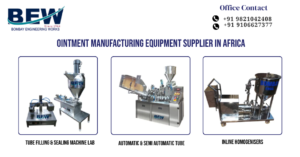
Ointment Manufacturing Equipment Supplier in Africa

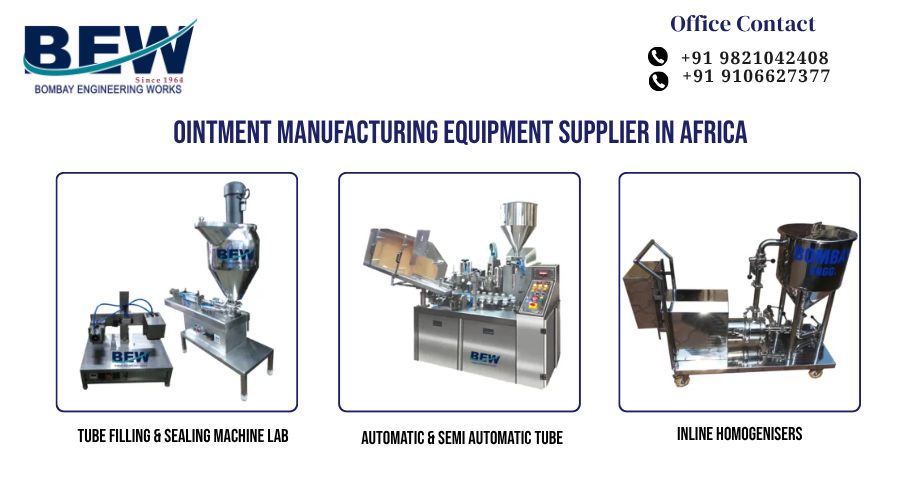




Ointment Manufacturing Equipment Supplier in Africa | Bombay Engg
If you are searching for an Ointment Manufacturing Equipment Supplier in Africa, Bombay Engg delivers process systems engineered for pharmaceutical, chemical, food, cosmetic, Ayurvedic, and herbal ointment production lines.
Bombay Engineering Works, established in 1964, manufactures and supplies machinery for pharmaceutical, chemical, food processing, cosmetic, Ayurvedic, and herbal industries. Its product portfolio includes equipment across ointment processing and other manufacturing sections, supporting different industrial applications. The company’s states that it has expanded from its early Tray Dryer manufacturing operations into a broader machinery portfolio serving multiple industries.
Call us today: 9821042408 Website: www.bombayengg.com
About Us
Bombay Engg has been associated with industrial machinery manufacturing since 1964. Over the decades, the company has developed expertise across several manufacturing sectors where dependable process equipment is essential.
The company’s machinery portfolio covers multiple industries, including pharmaceuticals, chemicals, food processing, cosmetics, Ayurvedic products, and herbal manufacturing.
This broad experience is important because every ointment processing application is different. A pharmaceutical ointment may require a different approach from a chemical paste, herbal balm, food-grade cream, or cosmetic emulsion.
Bombay Engg focuses on manufacturing and supplying industrial machinery according to the application, production requirements, and process conditions of its customers.
Understanding Ointment Manufacturing Equipment and Its Role
Ointment manufacturing equipment refers to a group of process machines used to prepare, mix, blend, and homogenize semi-solid and viscous products in industrial settings.
Unlike simple mixing tanks that only stir ingredients, complete ointment manufacturing systems combine multiple stages to achieve a uniform, stable, and production-ready semi-solid batch.
When ingredients are combined under controlled conditions, the finished ointment can meet the required viscosity, homogeneity, and quality parameters.
In simple terms, ointment manufacturing equipment combines:
- Mixing vessels and jacketed tanks
- Agitators and stirrers
- Heating and cooling arrangements
- Homogenizers
- Transfer pumps
- Filtration and transfer lines
- Control and monitoring systems
Together, these components create a controlled ointment manufacturing process.
Step-by-Step Process of Ointment Manufacturing
Understanding the working principle is useful before selecting an Ointment Manufacturing Equipment Supplier in Africa.
Charging the Ingredients
Raw materials are transferred into the main mixing vessel in the required sequence.
Proper charging sequence is important because the order of addition can influence mixing quality and uniformity.
Mixing and Agitation
The agitator or stirrer blends the ingredients to achieve the required homogeneity.
The mixing speed, type of agitator, and mixing time are selected according to the product formulation.
Heating or Cooling
Depending on the formulation, the ointment base may need to be heated or cooled during processing.
Temperature control helps maintain product consistency and supports the required reaction or dissolution.
Homogenization
A homogenizer may be used to reduce particle size and improve uniformity.
This step is important for emulsions, suspensions, and products that require a smooth, stable texture.
Quality Verification
Samples may be checked for pH, viscosity, density, and appearance.
Quality checks help confirm that the batch meets the required specification before transfer or filling.
Transfer and Storage
The finished ointment is transferred to storage or filling through suitable pumps and lines.
Proper transfer design helps maintain product quality and reduce contamination risk.
Cleaning and Changeover
Equipment is cleaned between batches to avoid cross-contamination.
The cleaning method depends on the product type, construction material, and regulatory requirements.
Why Controlled Ointment Processing Matters for Sensitive Formulations
One of the main reasons industries consider controlled ointment processing is formulation sensitivity.
Some products cannot tolerate high shear, excessive heat, or prolonged processing. Basic mixing can sometimes expose such formulations to conditions that may negatively affect their quality.
Controlled ointment manufacturing addresses this challenge by regulating speed, temperature, and processing time.
Because parameters can be adjusted precisely, manufacturers can achieve the required result while protecting product characteristics.
This can be particularly relevant in pharmaceutical and herbal applications where maintaining the desired properties of the processed ointment is important.
Benefits of Using Ointment Manufacturing Equipment
A properly designed ointment manufacturing system can offer several advantages for industrial production.
Consistent Batch Quality
Controlled mixing and processing helps achieve uniform batches.
This makes ointment manufacturing suitable for many products where consistency is critical.
Precise Process Control
Speed, temperature, and processing time can be controlled during the process.
This allows manufacturers to establish repeatable conditions for specific formulations.
Reduced Contamination Risk
Because the process takes place in enclosed vessels, exposure to external contamination can be reduced compared with open processing methods.
This can be useful for products that are sensitive to environmental exposure.
Product Quality Protection
For appropriate applications, controlled processing can help protect important product characteristics.
These may include colour, aroma, chemical stability, and physical properties.
Better Moisture Control
The ointment manufacturing process can be designed around a target moisture level.
This is particularly important in industries where residual moisture affects product stability, storage, handling, or downstream processing.
Industries That Rely on Ointment Manufacturing Equipment
The application of ointment manufacturing equipment extends across numerous industries.
Pharmaceutical Industry
The pharmaceutical industry often requires controlled processing of sensitive ointment formulations.
Ointment manufacturing equipment may be used for suitable creams, gels, and semi-solid products where controlled mixing is important.
Chemical Industry
Chemical manufacturers process a wide range of semi-solid materials with different physical and chemical characteristics.
Controlled ointment processing can be useful when a formulation requires uniform mixing without excessive shear or heat.
Food Processing Industry
Food semi-solids can be sensitive to heat, contamination, and processing conditions.
Ointment manufacturing equipment can be considered for selected food products where controlled mixing is required.
Cosmetic Industry
Cosmetic manufacturing involves various lotions, creams, gels, and semi-solid formulations.
For suitable products, controlled ointment processing can help achieve the desired texture and uniformity.
Ayurvedic and Herbal Industry
Ayurvedic and herbal products frequently involve plant-based extracts and semi-solid preparations.
Some botanical semi-solids are sensitive to excessive heat or aggressive mixing.
Selecting Ointment Manufacturing Equipment for Chemical and Pharmaceutical Needs
Some formulations may require gentle mixing, while others may need specific temperature or viscosity conditions.
Ointment manufacturing equipment can be useful for applications where controlled processing is desirable.
The selection process should consider:
- Material characteristics
- Initial viscosity
- Final product specification
- Batch size
- Processing temperature
- Mixing requirements
- Heating and cooling medium
- Solvent characteristics, where applicable
- Transfer and filling needs
- Material of construction
- Cleaning requirements
- Safety requirements
E-E-A-T (Experience, Expertise, Authoritativeness, Trustworthiness)
Experience
Established in 1964, Bombay Engg brings decades of experience in manufacturing and supplying pharmaceutical, chemical, food processing, cosmetic, Ayurvedic, and herbal machinery.
Expertise
With specialized knowledge of industrial process machinery and ointment processing equipment, Bombay Engg develops ointment manufacturing solutions based on product characteristics, capacity, temperature, and process requirements.
Authoritativeness
Bombay Engg has built a long-standing presence in the industrial machinery sector by serving diverse manufacturing industries with process equipment and machinery solutions.
Trustworthiness
Bombay Engg focuses on application-oriented machinery, transparent technical discussions, dependable manufacturing, and customer support to help industries select suitable equipment for their production requirements.
Frequently Asked Questions (FAQs)
Q1. What is Ointment Manufacturing Equipment used for?
Ans: Ointment manufacturing equipment is used to mix, blend, and process semi-solid and viscous products under controlled conditions, making it useful for many formulations in pharmaceutical, chemical, food, cosmetic, Ayurvedic, and herbal industries.
Q2. Why choose controlled ointment manufacturing for sensitive formulations?
Ans: Controlled ointment manufacturing can process formulations at comparatively gentler conditions because speed, temperature, and time can be regulated, helping provide consistent processing for suitable sensitive semi-solids.
Q3. Which industries use Ointment Manufacturing Equipment?
Ans: Ointment manufacturing equipment is commonly considered for suitable applications in pharmaceutical, chemical, food processing, cosmetic, Ayurvedic, herbal, nutraceutical, and other process industries.
Q4. Can Ointment Manufacturing Equipment be customized for industrial requirements?
Ans: Yes, ointment manufacturing equipment can be configured according to requirements such as batch capacity, vessel size, material of construction, heating and cooling method, mixing type, product characteristics, and processing conditions.
Q5. How can I contact an Ointment Manufacturing Equipment Supplier in Africa?
Ans: You can contact Bombay Engg at 9821042408 to discuss your product, batch capacity, processing requirements, and suitable ointment manufacturing equipment configuration.
Contact Us
Address: Unit No. 9, Unity Industrial Estate, Naikpada, Valiv Village, Near Ganesh Mandir, Vasai East, Dist: Palghar-401208.
Phone: +91 9821042408 / +91 9106627377
Email: info@bombayengg.com / admin@bombayengg.com / support@bombayengg.com
Website: www.bombayengg.com
Conclusion
Choosing an experienced Ointment Manufacturing Equipment Supplier in Africa is important when your production process requires controlled mixing, consistent quality, and careful handling of suitable semi-solid formulations. Bombay Engg, established in 1964, offers industrial machinery solutions for pharmaceutical, chemical, food processing, cosmetic, Ayurvedic, and herbal manufacturing applications.
Before selecting ointment manufacturing equipment, manufacturers should consider factors such as product characteristics, batch capacity, viscosity, required processing temperature, mixing conditions, material of construction, heating arrangement, and production requirements. For machinery enquiries and application discussions, contact Bombay Engg.
Call Bombay Engg today: 9821042408
Visit: www.bombayengg.com
“Don’t forget to share this post!”