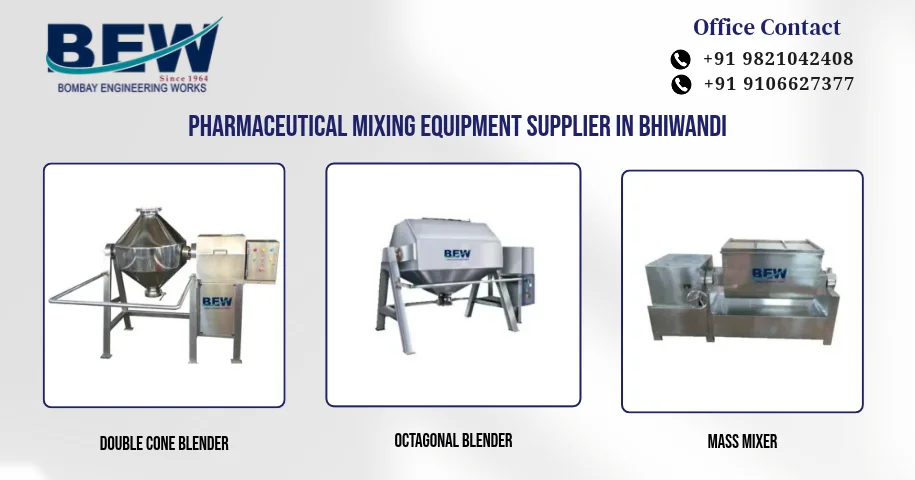
Pharmaceutical Mixing Equipment Supplier in Bhiwandi





Pharmaceutical Mixing Equipment Supplier in Bhiwandi | Bombay Engineering Works
The pharmaceutical industry depends on accuracy, consistency, hygiene, and reliable manufacturing processes. From preparing liquid medicines and syrups to blending pharmaceutical powders and producing creams, every stage requires equipment that can deliver uniform results. Therefore, selecting the right Pharmaceutical Mixing Equipment Supplier in Bhiwandi is an important decision for pharmaceutical manufacturers, formulation companies, contract manufacturers, and businesses involved in pharmaceutical processing.
Pharmaceutical mixing equipment plays a vital role in combining ingredients, distributing active pharmaceutical ingredients (APIs), maintaining batch consistency, and achieving the required product characteristics. However, not every formulation requires the same mixing technology. Liquid preparations, viscous ointments, suspensions, and dry powders have different processing requirements. Consequently, manufacturers must evaluate equipment design, material compatibility, mixing performance, cleaning requirements, and production capacity before investing in a machine.
Call us today: 9821042408 Website: www.bombayengg.com
About Bombay Engineering Works
Bombay Engineering Works, established in 1964, is a manufacturer and supplier of industrial machinery serving the pharmaceutical, chemical, food processing, cosmetic, Ayurvedic, and herbal industries. The company provides machinery solutions designed to support different manufacturing and processing requirements across various industrial sectors.
With decades of industry experience, Bombay Engineering Works focuses on helping businesses identify suitable machinery based on their production processes, equipment requirements, and operational needs. Its diverse product categories make the company a potential partner for manufacturers seeking reliable industrial processing solutions.
Key Areas of Expertise:
- Pharmaceutical Machinery
- Chemical Processing Machinery
- Food Processing Machinery
- Cosmetic Manufacturing Machinery
- Ayurvedic and Herbal Machinery
- Industrial Mixing and Processing Equipment
What Is Pharmaceutical Mixing Equipment?
Pharmaceutical mixing equipment refers to machinery designed to combine two or more ingredients to achieve a consistent and controlled mixture. Depending on the formulation, the equipment may blend liquids, disperse powders into liquids, mix semi-solid materials, or distribute dry ingredients throughout a batch.
Unlike general-purpose industrial mixers, pharmaceutical mixing equipment must be selected according to the product’s physical properties, formulation requirements, hygiene expectations, and manufacturing process.
For example, a liquid oral formulation may require controlled agitation to distribute ingredients uniformly. In contrast, an ointment manufacturing process may need a system capable of handling viscous materials and producing a smooth, consistent product.
The main objective is to achieve the required mixing performance without compromising product quality.
Why Is Pharmaceutical Mixing Important?
Pharmaceutical mixing influences several aspects of manufacturing, including:
- Content uniformity: Helps distribute ingredients consistently throughout a batch.
- Product consistency: Supports repeatable texture, appearance, and other relevant product characteristics.
- Process efficiency: Helps reduce unnecessary processing time when the equipment is correctly selected.
- Ingredient dispersion: Supports the incorporation and distribution of suitable ingredients.
- Batch reproducibility: Helps manufacturers maintain a controlled and repeatable process.
- Manufacturing hygiene: Equipment designed for the application can support appropriate cleaning and contamination-control procedures.
Nevertheless, equipment alone cannot guarantee a uniform or compliant product. Formulation development, validated procedures, operator training, process controls, and quality testing remain essential.
Why Choose a Pharmaceutical Mixing Equipment Supplier in Bhiwandi?
Choosing a supplier is not simply about purchasing a machine. It involves identifying a suitable manufacturing partner who understands your production requirements and can provide relevant technical information.
Businesses searching for a Pharmaceutical Mixing Equipment Supplier in Bhiwandi should evaluate the supplier’s product range, manufacturing capabilities, equipment specifications, and ability to support the intended application.
1. Better Coordination for Industrial Projects
For businesses operating in Bhiwandi and nearby industrial areas, a supplier serving the wider Maharashtra market may simplify communication, technical discussions, and project coordination. Depending on the supplier’s location and service arrangements, regional sourcing may also make equipment inspections and follow-up discussions more convenient.
2. Equipment Selection Based on the Application
A reliable supplier should understand whether your process involves liquid-liquid mixing, powder blending, solid-liquid dispersion, or semi-solid preparation.
This distinction matters because the impeller, vessel geometry, motor capacity, mixing speed, and other design parameters influence performance.
3. Support for Production Planningav
Manufacturers must consider more than the purchase price. Batch size, production frequency, cleaning time, equipment installation, utility requirements, and future capacity expansion all affect the total investment.
A technically informed supplier can help you compare appropriate configurations against these requirements.
4. Access to Different Machinery Categoriesab
Pharmaceutical manufacturing facilities may require several types of machinery throughout their production processes. Working with a manufacturer serving multiple industries can be helpful when evaluating complementary equipment for a broader manufacturing project.
Bombay Engineering Works operates across pharmaceutical, chemical, food processing, cosmetic, Ayurvedic, and herbal machinery categories.
5. Long-Term Equipment Considerations
Before purchasing, ask about spare parts, operating instructions, maintenance requirements, warranty terms, and the availability of technical assistance. These details help establish realistic expectations for equipment ownership.
Types of Pharmaceutical Mixing Equipment
Pharmaceutical mixing equipment is available in several configurations. Each type serves particular applications, and the correct selection depends on the formulation, viscosity, batch size, processing objective, and required level of control.
1. Liquid Mixing Equipment
Liquid mixing equipment is used to combine compatible liquid ingredients and maintain the required level of uniformity. Depending on the formulation, it may also help distribute dissolved materials or suspend suitable particles.
Typical applications include the preparation of selected liquid pharmaceutical products, process solutions, and other formulations where controlled agitation is required.
Important selection factors include:
- Liquid viscosity and density.
- Vessel capacity and geometry.
- Impeller type and operating speed.
- Required mixing time.
- Foam formation and air entrainment.
- Temperature requirements, where applicable.
- Cleaning and product-contact material requirements.
The mixer should be evaluated using the actual formulation or a representative process material whenever practical.
2. Pharmaceutical Powder Mixing Equipment
Powder mixing equipment is designed to blend dry ingredients into a sufficiently uniform mixture. It is used in processes involving pharmaceutical powders and other dry formulation ingredients.
However, powder blending can be complex. Particle size, density, shape, moisture content, electrostatic effects, and ingredient proportions may influence the final result.
A suitable powder mixer should therefore be selected based on the characteristics of the materials and the required blending performance.
Manufacturers should assess:
- Batch capacity and working volume.
- Powder flow characteristics.
- Risk of segregation during mixing or discharge.
- Ease of loading and unloading.
- Dust containment requirements.
- Cleaning accessibility.
- Sampling and blend-uniformity verification procedures.
The most appropriate mixer is the one that demonstrates suitable performance for the actual materials rather than simply offering the largest capacity.
3. High-Shear Mixing Equipment
High-shear mixers use a rotor-stator arrangement or another suitable high-energy mixing mechanism to produce intense local shear. Depending on the design, these systems can help disperse ingredients, reduce agglomerates, and create emulsions or dispersions.
They may be considered for selected pharmaceutical liquids, creams, suspensions, and other formulations that benefit from high-shear processing.
4. Homogenizing Equipment
Homogenizing equipment is used when a process requires a more uniform distribution of dispersed phases or a controlled reduction in droplet or particle size.
For instance, a high-pressure homogenizer may be appropriate for certain emulsions or suspensions, while a rotor-stator homogenizer may suit other mixing and dispersion applications.
5. Ointment and Cream Mixing Equipment
Ointments and creams often have higher viscosities than ordinary liquids. As a result, their preparation may require mixing equipment designed to handle semi-solid materials without leaving excessive unmixed areas.
Depending on the formulation, manufacturers may consider anchor agitators, scraper arrangements, high-shear mixing systems, or vacuum-capable processing vessels.
6. Jacketed Mixing Vessels
A jacketed mixing vessel has an outer jacket through which a suitable heating or cooling medium can circulate. It can support temperature management during processes that require controlled thermal conditions.
Jacketed vessels may be considered for selected pharmaceutical liquids, creams, ointments, and other temperature-sensitive or temperature-dependent processes.
Applications of Pharmaceutical Mixing Equipment
Pharmaceutical mixing machinery supports a range of manufacturing processes. The equipment configuration should always match the intended product and its processing requirements.
Liquid Oral Formulations
Selected liquid oral products require the controlled combination of ingredients, suitable dispersion, and maintenance of the intended physical characteristics.
Mixing conditions depend on whether ingredients dissolve, remain suspended, or form another type of dispersion. A mixer suitable for one formulation may not be appropriate for another.
Creams, Ointments, and Gels
Topical preparations may require the incorporation of powders, oils, water-based phases, thickeners, and other ingredients.
Depending on the formulation, the manufacturing process may involve heating, cooling, high-shear dispersion, vacuum deaeration, or controlled low-shear agitation.
Pharmaceutical Suspensions
Suspensions contain solid particles distributed in a liquid medium. Mixing may help disperse the particles and maintain an appropriate distribution during processing.
However, mixing alone does not guarantee long-term suspension stability. Particle characteristics, formulation design, viscosity, and other product properties also influence performance.
Powder Blends
Dry powder blending is relevant to selected pharmaceutical manufacturing processes. The mixer must accommodate the physical properties of the ingredients while supporting the required blend uniformity.
Testing and process controls are necessary to verify whether the finished blend meets its predefined specifications.
Key Features to Evaluate Before Buying Pharmaceutical Mixing Equipment
Selecting equipment based only on a product name or advertised capacity can lead to operational difficulties. Instead, evaluate the following technical and commercial factors before making a decision.
1. Construction Material
Product-contact surfaces must be compatible with the ingredients, cleaning agents, and operating conditions.
Stainless steel grades are commonly considered for pharmaceutical equipment, but the correct grade depends on the formulation and process environment. Corrosion resistance, surface finish, fabrication quality, and the risk of material interaction should all be assessed.
Request documentation for the proposed product-contact materials where required.
2. Mixing Capacity
Manufacturers should distinguish between total vessel volume and usable working volume. A vessel’s actual working capacity depends on the mixing mechanism, product characteristics, operating conditions, and required headspace.
A larger vessel is not automatically more efficient. An undersized mixer may restrict output, while an oversized system may create difficulties with low-volume batches or mixing performance.
3. Agitator and Impeller Design
The agitator affects circulation, shear, energy transfer, and mixing performance.
Common configurations include propellers, turbines, paddles, anchors, and rotor-stator arrangements. Each has specific operating characteristics.
The supplier should explain why the proposed configuration suits the material’s viscosity and the process objective.
4. Speed and Process Control
Different formulations require different mixing conditions. Variable-speed drives may provide flexibility where a process needs adjustable agitation.
However, speed alone does not establish mixing quality. Impeller geometry, vessel dimensions, viscosity, fill level, and operating time also influence performance.
Where necessary, specify measurable acceptance criteria and define how the mixing process will be verified.
Pharmaceutical Mixing Equipment for Businesses in Bhiwandi and Nearby Industrial Areas
A buyer in Bhiwandi may compare suppliers serving Thane, Mumbai, Vasai, and other industrial locations in Maharashtra. However, the most suitable supplier is the one that can demonstrate an appropriate equipment configuration, provide clear specifications, and meet the project’s delivery and support requirements.
For pharmaceutical manufacturers, equipment selection should begin with the intended manufacturing process rather than geographical availability alone.
Bhiwandi is associated with warehousing, distribution, and a variety of industrial activities. Businesses operating in the wider Mumbai Metropolitan Region may need to coordinate machinery procurement with production planning, facility preparation, and logistics.
Before confirming an order, verify the supplier’s current manufacturing location, dispatch arrangements, installation scope, and service coverage. These details should be established directly rather than assumed from the supplier’s service area.
E-E-A-T (Experience, Expertise, Authoritativeness & Trustworthiness)
Experience
Established in 1964, Bombay Engineering Works brings decades of experience in industrial machinery manufacturing and supply.
Expertise
Specializes in machinery for pharmaceutical, chemical, food processing, cosmetic, Ayurvedic, and herbal industries.
Authoritativeness
Serves multiple industrial sectors with machinery solutions designed around diverse manufacturing requirements.
Trustworthiness
Encourages buyers to verify equipment specifications, material compatibility, documentation, and service arrangements before purchasing.
Frequently Asked Questions (FAQs)
Q1. How do I select the right pharmaceutical mixer for my production facility?
Ans: Start by defining the product characteristics, required batch capacity, mixing objective, temperature conditions, cleaning requirements, and applicable quality standards. Then compare suppliers using detailed technical specifications and suitable performance criteria.
Q2. Why is stainless steel commonly used in pharmaceutical mixing equipment?
Ans: Suitable stainless steel grades can offer corrosion resistance, cleanable surfaces, and compatibility with many pharmaceutical processing applications. The correct material grade and surface finish must be determined according to the product, cleaning agents, and process conditions.
Q3. Can one pharmaceutical mixer handle different formulations?
Ans: Some mixing systems can process multiple formulations, provided their design, operating range, materials, and cleaning procedures are suitable for each product. Compatibility and cross-contamination controls must be assessed before sharing equipment.
Q4. What information should I provide when requesting a quotation?
Ans: Provide the product type, material properties, batch size, required output, mixing objective, operating temperature, contact-material requirements, cleaning expectations, utilities, and any relevant documentation requirements.
Q5. How can I contact Bombay Engineering Works?
Ans: You can contact Bombay Engineering Works at 9821042408 or visit https://bombayengg.com/ to discuss your pharmaceutical machinery requirements and request relevant equipment information.
Contact Us
Address: Unit No. 9, Unity Industrial Estate, Naikpada, Valiv Village, Near Ganesh Mandir, Vasai East, Dist: Palghar-401208.
Phone: +91 9821042408 / +91 9106627377
Email: info@bombayengg.com / admin@bombayengg.com / support@bombayengg.com
Website: www.bombayengg.com
Conclusion
Choosing the right Pharmaceutical Mixing Equipment Supplier in Bhiwandi requires a careful assessment of the manufacturing process, formulation characteristics, production capacity, equipment construction, cleaning requirements, and long-term operating needs. A suitable mixer can support consistent processing and efficient production when it is correctly specified, installed, operated, and maintained. Therefore, pharmaceutical manufacturers should compare technical suitability and documented capabilities rather than making a decision based only on price or advertised capacity.
Bombay Engineering Works, established in 1964, manufactures and supplies machinery for pharmaceutical, chemical, food processing, cosmetic, Ayurvedic, and herbal applications. Businesses looking for pharmaceutical mixing machinery can discuss their requirements with the company, review the available configurations, and confirm the technical specifications relevant to their projects.
Call Bombay Engg today: 9821042408
Visit: www.bombayengg.com
“Don’t forget to share this post!”