Pharmaceutical Milling Equipment Supplier in New Zealand

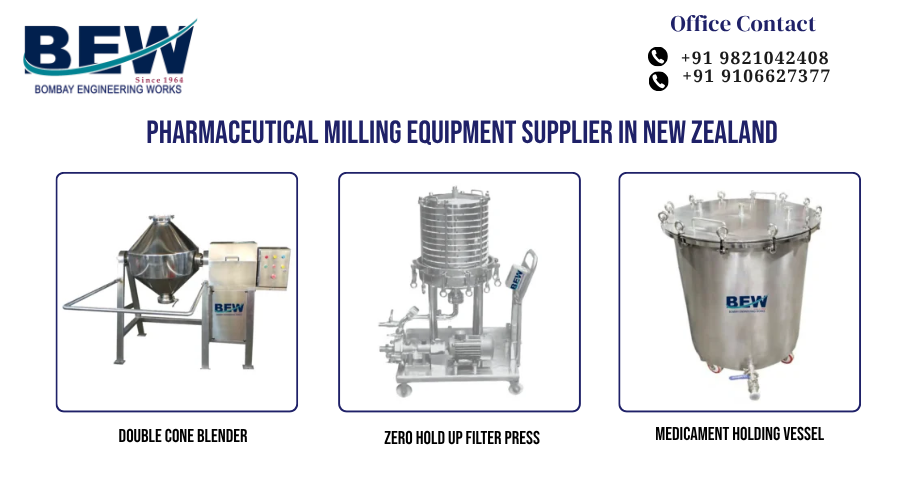




Pharmaceutical Milling Equipment Supplier in New Zealand | Bombay Engg
Pharmaceutical producers in New Zealand rely on dependable milling technology to protect product quality and keep processing lines running smoothly. Milling plays a central role in pharmaceutical manufacturing, where controlled particle size reduction supports blending, dosing, and downstream handling. Working with a capable Pharmaceutical Milling Equipment Supplier in New Zealand helps manufacturers secure equipment that fits their production and compliance needs.
Bombay Engineering Works is a well-established machinery manufacturer that has been active since 1964. The firm builds and supplies equipment for pharmaceutical, chemical, food processing, cosmetic, and Ayurvedic and herbal applications. Its long manufacturing history gives it a practical understanding of equipment design, dependable operation, and process-specific production needs.
Call us today: 9821042408 Website: www.bombayengg.com
Why Work With Bombay Engineering Works?
Bombay Engineering Works has been building machinery since 1964, creating a solid reputation in industrial equipment manufacturing. The company supplies machinery for several sectors, including pharmaceutical, chemical, food processing, cosmetic, and Ayurvedic and herbal industries.
Advantages of reaching out to Bombay Engineering Works include:
- Operating since 1964: Extensive experience in machinery production.
- Broad industry coverage: Practical knowledge across pharmaceutical and other process-driven sectors.
- Application-led conversations: A chance to outline your milling goals and technical parameters.
- Manufacturing know-how: A business centred on equipment for industrial processing tasks.
- Direct contact: Reach out to discuss specifications, availability, and project needs.
Equipment availability, milling-system configurations, material choices, and documentation should be confirmed directly with the company. Buyers should request full specifications before deciding whether a proposed machine fits a specific pharmaceutical application.
What Does Pharmaceutical Milling Equipment Do?
Pharmaceutical milling equipment reduces the particle size of solid materials, breaks down agglomerates, and creates more uniform powders for further processing. Depending on the application, milling may support granulation, blending, or size reduction before tableting or capsule filling.
These systems can assist different production stages, including preparation of dry powders, processing of granules, and size reduction of compatible materials. However, the right equipment depends on the product, feed characteristics, target particle size, operating conditions, and relevant quality requirements.
For pharmaceutical manufacturers, selecting the correct milling system helps establish a consistent process and supports product quality when the equipment is properly specified, operated, cleaned, and maintained.
Why Is Pharmaceutical Milling Important?
Milling plays an important role in pharmaceutical manufacturing because particle size can directly influence blending, flow, compression, and dissolution behaviour. A suitable milling solution helps manufacturers control particle distribution according to the requirements of their specific applications.
Key benefits of pharmaceutical milling include:
- Particle size control: Helps produce consistent particle distribution for downstream processing.
- Improved blend uniformity: Supports more homogeneous mixing when particle sizes are controlled.
- Better flow properties: Can improve powder flow during tableting and capsule filling.
- Enhanced dissolution: Smaller particles may increase surface area and support faster dissolution in suitable formulations.
- Improved process efficiency: A correctly selected mill can support practical production workflows and reduce avoidable processing interruptions.
- Quality management support: Properly designed milling processes can form part of a broader pharmaceutical quality-control strategy.
Nevertheless, milling alone does not guarantee product uniformity, potency, or regulatory compliance. Those outcomes depend on the complete process, equipment validation where required, suitable mill selection, operating procedures, and documented quality controls.
Types of Pharmaceutical Milling Equipment
Different pharmaceutical applications require different milling technologies. Consequently, manufacturers should evaluate the process requirements before choosing a particular system.
1. Conical Mills
Conical mills help reduce the size of dry and wet materials through a rotating impeller and a perforated screen. They may be considered for granulation, deagglomeration, and other compatible pharmaceutical processing tasks.
The appropriate configuration depends on the material’s hardness, moisture content, feed size, and desired output particle size. Manufacturers should also consider cleaning requirements and whether the equipment is suitable for the intended product-contact application.
2. Hammer Mills
Hammer mills use high-speed rotating hammers to impact and break down solid materials, producing a controlled particle size range. They are commonly associated with dry size reduction in suitable industrial processes.
In pharmaceutical-related applications, suitability depends on the material being processed, contamination-control requirements, cleaning procedures, and the need to prevent cross-contamination. A hammer mill should only be selected when its operating principle and construction match the process requirements.
3. Pin Mills
Pin mills use rotating pins to grind and deagglomerate materials, often producing fine powders. Different pin configurations and operating speeds are available for different process requirements.
These systems may be used for fine grinding, deagglomeration, or other suitable applications. Where a specific particle size distribution is required, the mill must be configured and tested for that purpose. A nominal size reduction capability alone does not establish process suitability.
4. Ball Mills
Ball mills are used to grind materials using grinding media inside a rotating cylinder. Depending on the design and application, they can provide a practical option for fine milling or uniform blending.
Before choosing a ball mill for pharmaceutical use, manufacturers should assess the grinding media, chamber construction, product compatibility, cleaning approach, and required contamination controls.
5. Jet Mills
Jet mills use compressed gas to accelerate particles and cause them to collide, producing very fine powders without mechanical grinding media. Depending on the technology, jet mills may be used for micronisation, fine grinding, or other specialised size reduction applications.
Jet mill selection requires careful consideration of feed size, target particle size, material hardness, pressure, temperature, and cleaning procedures. The intended use determines whether a jet mill is appropriate for a particular pharmaceutical process.
Applications of Pharmaceutical Milling Equipment
Pharmaceutical milling equipment can support a variety of manufacturing operations. However, the exact application depends on the product formulation, process design, and required quality controls.
Common application areas include:
- Dry powder processing: Reducing particle size of suitable solid materials before further processing.
- Granulation: Supporting the preparation of uniform granules for tableting.
- Deagglomeration: Breaking down lumps and agglomerates in selected production stages.
- Blending support: Creating more uniform particle distributions before mixing.
- Chemical and pharmaceutical processing: Assisting with suitable size reduction tasks.
- Pre-milling operations: Reducing feed size before a subsequent milling stage.
- Research and pilot production: Supporting small-scale or specialised processes when the selected equipment matches the required operating conditions.
It is important to distinguish ordinary milling from processes that require strict containment. Pharmaceutical applications involving potent or sterile products require a properly designed and validated process, appropriate equipment selection, and relevant containment controls.
How to Choose the Right Pharmaceutical Milling Equipment Supplier in New Zealand
Selecting a suitable supplier involves more than comparing equipment prices. Businesses should assess the supplier’s manufacturing experience, technical understanding, equipment specifications, and ability to address the intended application.
Consider the following factors before making a decision.
Manufacturing Experience
An established supplier may bring valuable experience in machinery design, fabrication, and industrial production requirements. Bombay Engineering Works was established in 1964 and serves multiple machinery sectors, including pharmaceutical and chemical processing.
When evaluating any supplier, ask about experience with equipment similar to your application and request relevant technical documentation.
Equipment Design and Material Compatibility
The equipment’s construction materials must be compatible with the product and cleaning agents. For pharmaceutical applications, buyers should assess product-contact surfaces, corrosion resistance, sealing arrangements, and the suitability of the design for the intended cleaning and operating procedures.
Where required, request material specifications, surface-finish details, and documentation supporting the proposed equipment configuration.
Milling Requirements
Clearly define the milling objective before selecting a system. Important parameters include the required particle size distribution, throughput, feed size, material hardness, temperature, and expected moisture content.
A manufacturer or technical supplier should be able to discuss these requirements and help identify a suitable equipment configuration. Performance should be confirmed against the actual process conditions rather than assumptions based only on the equipment category.
Cleaning and Maintenance
Pharmaceutical equipment must be suitable for the cleaning and maintenance procedures established for its intended use. Evaluate accessibility, screen and impeller replacement, inspection requirements, spare-part availability, and the procedures needed to prevent cross-contamination.
Buyers should confirm the exact documentation needed before finalising the equipment specification.
Depending on the application, pharmaceutical manufacturers may require equipment drawings, material certificates, operating manuals, inspection records, and supporting qualification documentation. Requirements vary according to the process, facility, product, and applicable regulations.
Documentation and Quality Requirements
Ask for operating and maintenance instructions before purchasing the equipment.
E-E-A-T (Experience, Expertise, Authoritativeness & Trustworthiness)
Experience
Founded in 1964, Bombay Engineering Works carries decades of expertise in manufacturing equipment for pharmaceutical, chemical, food processing, cosmetic, and Ayurvedic industries.
Expertise
The company focuses on industrial machinery production, serving varied processing needs across multiple industries. Its team can discuss milling parameters and equipment options for specific applications.
Authoritativeness
With a longstanding presence in machinery manufacturing, Bombay Engineering Works is recognised as a dependable name in the industrial equipment sector.
Trustworthiness
Bombay Engineering Works invites customers to discuss their technical needs directly to receive relevant product information and make informed equipment decisions.
Frequently Asked Questions (FAQs)
Q1. Who is a pharmaceutical milling equipment supplier in New Zealand?
Ans: Bombay Engineering Works is an established machinery manufacturer founded in 1964, serving pharmaceutical and other industrial sectors. Businesses can contact the company at 9821042408 to discuss their specific milling equipment requirements and confirm available solutions.
Q2. What is pharmaceutical milling equipment used for?
Ans: Pharmaceutical milling equipment helps reduce the particle size of solid materials and break down agglomerates. It can support granulation, deagglomeration, and other manufacturing operations, depending on the selected technology and application.
Q3. What types of pharmaceutical milling systems are available?
Ans: Common milling technologies include conical mills, hammer mills, pin mills, ball mills, and jet mills. Each technology serves different purposes, so the correct choice depends on process conditions and required particle size distribution.
Q4. How do I select the right pharmaceutical milling equipment?
Ans: Consider the material being processed, required particle size, throughput, feed size, material hardness, product-contact materials, cleaning procedures, and documentation requirements. Discuss these details with the equipment manufacturer before confirming a purchase.
Q5. Is milling equipment enough to ensure pharmaceutical product quality?
Ans: No. Milling equipment alone does not guarantee product quality. Consistent manufacturing requires a suitable, qualified milling process, appropriate equipment selection, validated procedures where applicable, and effective quality-control measures.
Contact Us
Address: Unit No. 9, Unity Industrial Estate, Naikpada, Valiv Village, Near Ganesh Mandir, Vasai East, Dist: Palghar-401208.
Phone: +91 9821042408 / +91 9106627377
Email: info@bombayengg.com / admin@bombayengg.com / support@bombayengg.com
Website: www.bombayengg.com
Conclusion
Choosing the right Pharmaceutical Milling Equipment Supplier in New Zealand is an important step towards establishing reliable pharmaceutical processing operations. Businesses should evaluate milling performance, material compatibility, equipment design, cleaning requirements, maintenance needs, and relevant documentation before making a purchase.
Established in 1964, Bombay Engineering Works manufactures machinery for pharmaceutical, chemical, food processing, cosmetic, and Ayurvedic and herbal industries. If your business is looking for suitable pharmaceutical machinery, contact Bombay Engineering Works at 9821042408 or visit www.bombayengg.com to discuss your requirements and obtain further product information.
Call Bombay Engg today: 9821042408
Visit: www.bombayengg.com
“Don’t forget to share this post!”