Liquid Manufacturing Plant Exporter from India

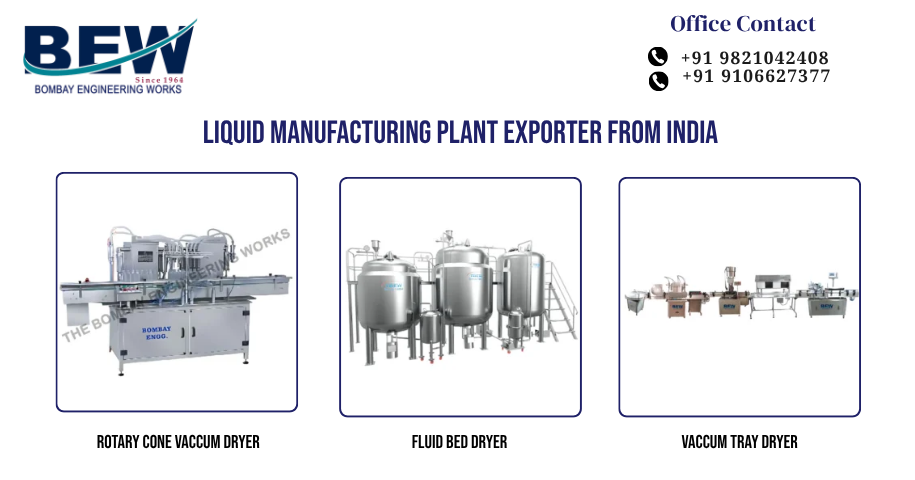




Liquid Manufacturing Plant Exporter from India
When industries require consistent, hygienic, and efficient liquid processing, the right manufacturing plant can make a significant difference to product quality and production efficiency. Bombay Engineering Works, established in 1964, is an experienced manufacturer, supplier, and Liquid Manufacturing Plant Exporter from India, serving diverse industrial requirements with reliable and application-focused machinery solutions.
With decades of engineering experience, Bombay Engineering Works provides machinery for the pharmaceutical, chemical, food processing, cosmetic, Ayurvedic, and herbal industries. The company focuses on practical engineering, robust construction, operational efficiency, and dependable performance to support modern manufacturing environments.
Call us today: 9821042408
Website: www.bombayengg.com
What Is a Liquid Manufacturing Plant?
A liquid manufacturing plant is an integrated processing system designed for the preparation, mixing, homogenization, storage, and transfer of liquid products. Depending on the application, the plant can incorporate different vessels, agitators, pumps, filtration systems, heating or cooling arrangements, and control systems.
The configuration depends on factors such as:
- Product formulation
- Batch size
- Viscosity
- Required mixing speed
- Temperature requirements
- Production capacity
- Material compatibility
- Hygiene and cleaning requirements
- Automation requirements
Therefore, a liquid manufacturing plant should not be considered a one-size-fits-all machine. Instead, the system should be engineered around the customer’s process and production objectives.
Why Choose Bombay Engineering Works as a Liquid Manufacturing Plant Exporter from India?
Bombay Engineering Works brings extensive engineering experience to industrial machinery manufacturing. Established in 1964, the company has developed expertise across pharmaceutical, chemical, food processing, cosmetic, Ayurvedic, and herbal machinery.
As a Liquid Manufacturing Plant Exporter from India, the company focuses on delivering machinery solutions that balance productivity, durability, process consistency, and ease of operation.
Key advantages include:
- Decades of engineering and manufacturing experience
- Application-oriented machinery design
- Solutions for multiple industrial sectors
- Customizable plant configurations
- Robust construction for industrial applications
- Focus on process efficiency and consistent production
- Support for different batch sizes and formulations
- Customer-focused technical assistance
Moreover, an experienced manufacturer can better understand the relationship between formulation characteristics, equipment selection, mixing requirements, and overall plant performance.
Applications of Liquid Manufacturing Plants
Liquid manufacturing plants are widely used across industries because many products require controlled liquid processing. Depending on the equipment configuration, these plants can support different stages of manufacturing.
Pharmaceutical Industry
In pharmaceutical manufacturing, liquid processing equipment may be used for products such as syrups, oral liquids, solutions, suspensions, and other formulations.
The equipment can be configured to support controlled mixing, heating, cooling, homogenization, and transfer according to the manufacturing process.
Cosmetic Industry
Cosmetic manufacturers use liquid processing systems for products such as shampoos, conditioners, lotions, creams, gels, and other personal-care formulations.
Proper agitation and homogenization can help manufacturers achieve a more uniform product while supporting repeatable batch production.
Chemical Industry
Chemical processing applications can involve liquids with different viscosities, temperatures, and chemical characteristics. Accordingly, plant construction and material selection should be determined by the specific formulation and process conditions.
Food Processing Industry
Liquid processing equipment is also used in food and beverage manufacturing for sauces, liquid ingredients, emulsions, syrups, and other products.
In these applications, hygienic construction, easy cleaning, controlled processing, and consistent mixing can be important considerations.
Ayurvedic and Herbal Industry
Ayurvedic and herbal manufacturers may require liquid processing systems for extracts, formulations, oils, syrups, and other plant-based products.
A properly designed manufacturing plant can help provide controlled and repeatable processing while accommodating the characteristics of herbal ingredients.
Major Equipment Used in a Liquid Manufacturing Plant
The exact equipment configuration varies according to the product and production process. However, a typical liquid manufacturing plant may include several essential components.
Manufacturing Vessel
The manufacturing vessel provides the primary space for processing and mixing the liquid formulation. It can be designed according to the required batch capacity and process conditions.
Agitator or Mixer
The agitator is responsible for creating controlled movement within the vessel. Mixer selection depends on factors such as viscosity, formulation characteristics, batch volume, and desired mixing performance.
Homogenizer
Where fine dispersion or emulsification is required, a homogenizer can be incorporated into the plant configuration. This is particularly useful for applications where consistent product texture or dispersion is important.
Storage Vessel
Storage vessels can be used to hold processed material before filling, packaging, or further processing. Their capacity and design depend on the production workflow.
Pumps and Transfer Systems
Suitable pumps and transfer arrangements allow liquid products to move between vessels or processing stages while maintaining an efficient production flow.
Heating and Cooling Systems
Some formulations require controlled heating or cooling during manufacturing. The plant can therefore be configured with suitable temperature-control arrangements based on process requirements.
Control and Instrumentation
Depending on the level of automation required, control systems and instrumentation can help monitor and manage parameters such as temperature, mixing, and processing time.
How Does a Liquid Manufacturing Plant Work?
Although the process varies between industries and formulations, liquid manufacturing generally follows a structured sequence.
1. Raw Material Charging
Required ingredients are introduced into the manufacturing vessel according to the formulation.
2. Mixing
The agitator operates at an appropriate speed to distribute the ingredients throughout the batch.
3. Heating or Cooling
Where required, the product temperature is controlled according to the manufacturing process.
4. Homogenization or Dispersion
If the formulation requires finer dispersion or emulsification, homogenization may be performed.
5. Quality and Process Checks
The batch can be evaluated according to the manufacturer’s defined process and quality parameters.
6. Transfer
The finished liquid is transferred to a storage vessel or the next stage of production.
7. Filling and Packaging
After processing and required quality checks, the product can proceed to filling and packaging.
This controlled workflow can help manufacturers achieve greater process consistency and efficient batch production.
Benefits of Using a Properly Designed Liquid Manufacturing Plant
Investing in a suitable liquid manufacturing plant can provide several operational advantages.
Improved Production Consistency
Controlled mixing and processing conditions can help manufacturers achieve greater consistency between batches.
Better Productivity
A properly integrated system can reduce unnecessary manual handling and support smoother material movement between production stages.
Flexible Manufacturing
Customizable vessels, mixers, transfer systems, and processing arrangements can allow manufacturers to address different formulations and batch sizes.
Efficient Process Control
Appropriate instrumentation can make it easier for operators to monitor important process parameters.
Hygienic Processing
For pharmaceutical, food, cosmetic, Ayurvedic, and herbal applications, suitable equipment design can support hygienic manufacturing practices and easier cleaning.
Long-Term Operational Value
Robust engineering and appropriate equipment selection can contribute to reliable plant operation and reduced process interruptions.
Why Source Liquid Manufacturing Plants from India?
India has developed a strong manufacturing ecosystem for industrial and process machinery. Consequently, international buyers often consider Indian machinery manufacturers for customized equipment and cost-effective engineering solutions.
Choosing an established Liquid Manufacturing Plant Exporter from India can offer advantages such as engineering expertise, customization, manufacturing capabilities, and access to a broad industrial machinery ecosystem.
However, buyers should evaluate manufacturers based on more than price. Technical experience, material quality, customization capability, documentation, after-sales support, and understanding of the intended application should also be considered.
How to Select the Right Liquid Manufacturing Plant
Before purchasing a plant, manufacturers should clearly define their production requirements.
Consider the following factors:
- Required batch capacity
- Product viscosity
- Formulation characteristics
- Required mixing and homogenization
- Operating temperature
- Material of construction
- Production frequency
- Cleaning requirements
- Automation level
- Available installation space
- Future production expansion
- Technical and after-sales support
Most importantly, discuss the formulation and manufacturing process with the equipment supplier before finalizing the design. This allows the plant configuration to be aligned with actual production requirements.
E-E-A-T: Why Experience and Technical Expertise Matter
Experience
Bombay Engineering Works was established in 1964, giving the company decades of experience in industrial machinery manufacturing.
Expertise
The company’s machinery portfolio covers pharmaceutical, chemical, food processing, cosmetic, Ayurvedic, and herbal machinery, supporting knowledge across different processing environments.
Authoritativeness
Long-term involvement in industrial machinery manufacturing helps establish technical familiarity with varied production requirements and equipment applications.
Trustworthiness
A dependable machinery partner should communicate clearly about equipment configuration, application suitability, technical specifications, customization, and support. Customers should always receive solutions based on their actual manufacturing requirements rather than generic equipment recommendations.
Frequently Asked Questions (FAQs)
Q1. What is a liquid manufacturing plant?
Ans: A liquid manufacturing plant is a processing system used to mix, process, homogenize, heat, cool, store, and transfer liquid formulations according to specific manufacturing requirements.
Q2. Who uses liquid manufacturing plants?
Ans: Liquid manufacturing plants are used across pharmaceutical, chemical, cosmetic, food processing, Ayurvedic, and herbal industries, among other applications.
Q3. Can a liquid manufacturing plant be customized?
Ans: Yes. Plant configuration can be developed according to batch capacity, formulation characteristics, viscosity, mixing requirements, temperature conditions, material compatibility, and automation needs.
Q4. Why choose a liquid manufacturing plant exporter from India?
Ans: An experienced Indian exporter can provide engineering expertise, customized machinery solutions, manufacturing capabilities, and access to a broad industrial machinery ecosystem.
Q5. How do I select the right liquid manufacturing plant?
Ans: Start by defining your batch size, formulation, viscosity, mixing requirements, operating temperature, material of construction, automation needs, and production workflow. Then discuss these requirements with an experienced machinery manufacturer.
Contact Bombay Engineering Works Today
Address: Unit No. 9, Unity Industrial Estate, Naikpada, Valiv Village, Near Ganesh Mandir, Vasai East, Dist: Palghar-401208.
Phone: +91 9821042408 / +91 9106627377
Email: info@bombayengg.com / admin@bombayengg.com / support@bombayengg.com
Website: www.bombayengg.com
Conclusion
A well-designed liquid manufacturing plant can become an important part of an efficient production facility. From controlled mixing and homogenization to temperature management, storage, and transfer, every component should be selected according to the product and manufacturing process.
With its establishment in 1964 and experience across pharmaceutical, chemical, food processing, cosmetic, Ayurvedic, and herbal machinery, Bombay Engineering Works provides industry-focused machinery solutions for diverse processing requirements. Businesses searching for a reliable Liquid Manufacturing Plant Exporter from India can consider technical expertise, customization, manufacturing quality, and long-term support when evaluating their equipment partner.
Call Bombay Engineering Works today: 9821042408
Visit: www.bombayengg.com
“Don’t forget to share this post!”