Small Scale Liquid Manufacturing Plant India

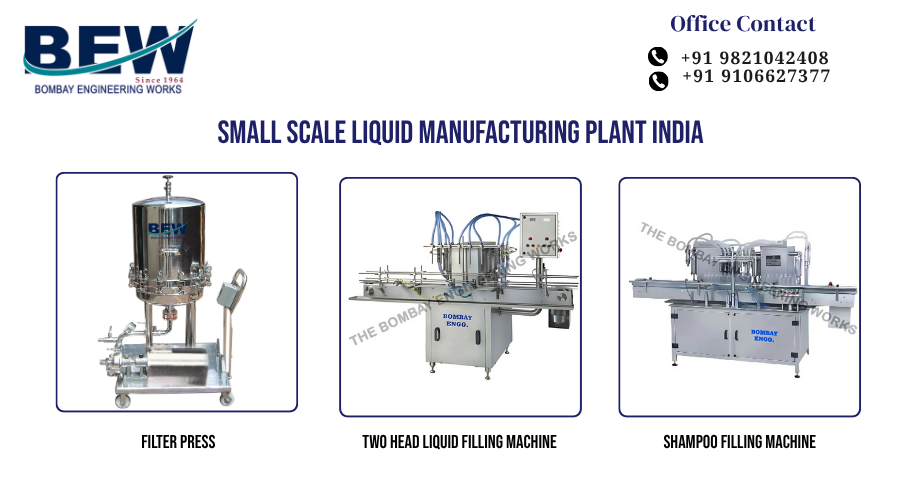




Small Scale Liquid Manufacturing Plant India
India’s manufacturing sector is evolving rapidly, and small and medium-sized businesses are increasingly looking for efficient ways to enter or expand within the liquid product manufacturing industry. Whether the requirement is for pharmaceuticals, cosmetics, chemicals, food products, herbal formulations, or other liquid-based products, a Small Scale Liquid Manufacturing Plant India can provide the flexibility needed to start production without investing in a very large industrial setup.
Bombay Engineering Works, established in 1964, manufactures and supplies a wide range of machinery for the pharmaceutical, chemical, food processing, cosmetic, Ayurvedic, and herbal industries. With decades of industry experience, the company focuses on providing practical machinery solutions for different manufacturing requirements.
Call us today: 9821042408
Website: www.bombayengg.com
About Bombay Engineering Works
Established in 1964, Bombay Engineering Works is a manufacturer and supplier of industrial machinery for various industries.
The company offers practical and application-focused machinery solutions for:
- Pharmaceutical Machinery
- Chemical Machinery
- Food Processing Machinery
- Cosmetic Machinery
- Ayurvedic & Herbal Machinery
For businesses planning a Small Scale Liquid Manufacturing Plant in India, Bombay Engineering Works provides customized equipment based on:
- Batch capacity and production requirements
- Product viscosity and characteristics
- Mixing and homogenization requirements
- Heating and cooling needs
- Material compatibility
- Storage, filtration, and transfer requirements
With decades of engineering experience, Bombay Engineering Works focuses on providing reliable machinery solutions designed around specific manufacturing processes.
What Is a Small Scale Liquid Manufacturing Plant?
A Small Scale Liquid Manufacturing Plant India is a compact industrial production system designed for manufacturing liquid products in relatively small or medium-sized batches.
Unlike a large-scale continuous production facility, a small-scale plant generally offers greater flexibility. Manufacturers can produce different formulations, change batches according to market demand, test new products, and gradually increase capacity as their business grows.
Such plants are commonly used for manufacturing:
- Pharmaceutical liquids
- Syrups
- Oral liquid formulations
- Cosmetic creams and lotions
- Shampoos
- Liquid soaps
- Herbal formulations
- Ayurvedic liquids
- Chemical solutions
- Detergents
- Food and beverage liquids
- Flavoured liquid products
- Personal care products
- Specialty liquid formulations
The exact machinery arrangement varies according to the product. For example, a low-viscosity liquid may require a conventional mixing system, while a viscous cosmetic or pharmaceutical formulation may need high-shear mixing or homogenization.
Therefore, a small-scale plant should not be selected simply according to tank capacity. Instead, the complete manufacturing process should be evaluated.
Why Is Small Scale Liquid Manufacturing Growing in India?
India has a diverse manufacturing ecosystem, supported by pharmaceutical, cosmetic, chemical, food processing, personal care, and traditional medicine industries. At the same time, consumer preferences are changing quickly. Businesses are introducing new formulations, private-label products, herbal products, specialty chemicals, and niche personal-care products. Consequently, manufacturers often need production systems that can handle smaller batches efficiently.
A small-scale liquid manufacturing plant can be particularly useful when a company wants to:
- Start a new manufacturing business
- Test a new formulation
- Produce multiple product variants
- Serve regional markets
- Manufacture private-label products
- Increase production gradually
- Reduce unnecessary initial capital expenditure
- Maintain greater control over production
- Develop customized formulations
Moreover, smaller batch production can help manufacturers respond more quickly to changing customer requirements.
What Products Can Be Manufactured in a Small-Scale Liquid Plant?
The applications of liquid manufacturing equipment are extensive, allowing small and medium-sized manufacturers to produce a wide range of liquid formulations across different industries.
Pharmaceutical Liquids
Pharmaceutical liquid manufacturing systems can be used for products such as syrups, oral liquids, suspensions, solutions, and other formulations. Depending on the formulation, the process may include raw material charging, purified water addition, heating, mixing, dissolution, homogenization, filtration, cooling, storage, and filling.
Cosmetics & Personal Care
Cosmetic liquid manufacturing equipment is commonly used for shampoos, conditioners, lotions, liquid cleansers, gels, creams, and other personal-care products. Mixing performance is particularly important because formulations can vary significantly in viscosity and physical characteristics.
Chemical & Specialty Liquids
Small-scale liquid plants can manufacture or process various liquid chemicals, solutions, formulations, and specialty products. Material compatibility is an important consideration, and the equipment construction should be selected according to the formulation and processing conditions.
Ayurvedic & Herbal Products
Small and medium-sized manufacturers can use liquid manufacturing plants for herbal syrups, extracts, oils, liquid formulations, and other Ayurvedic preparations. Plant configuration can be customized according to the raw materials, viscosity, processing temperature, and specific manufacturing requirements.
Food & Beverage Liquids
Liquid manufacturing equipment can also be used for food and beverage applications requiring controlled mixing, heating, cooling, storage, and filling. Machinery selection should consider food-grade construction, cleaning requirements, product viscosity, temperature, and ingredient characteristics.
Key Machinery Required for a Small-Scale Liquid Manufacturing Plant
A complete plant may include several interconnected machines, depending on the product and manufacturing process.
1. Manufacturing Vessel
The manufacturing vessel is the central component used for combining raw materials and carrying out controlled processing. It may include agitators, heating or cooling systems, temperature sensors, cleaning arrangements, and product connections. Capacity should be selected according to the required batch size.
2. Liquid Mixing Equipment
Mixing systems distribute ingredients evenly and achieve the required consistency. Agitator selection depends on product viscosity, batch size, solids content, temperature, mixing time, and required shear.
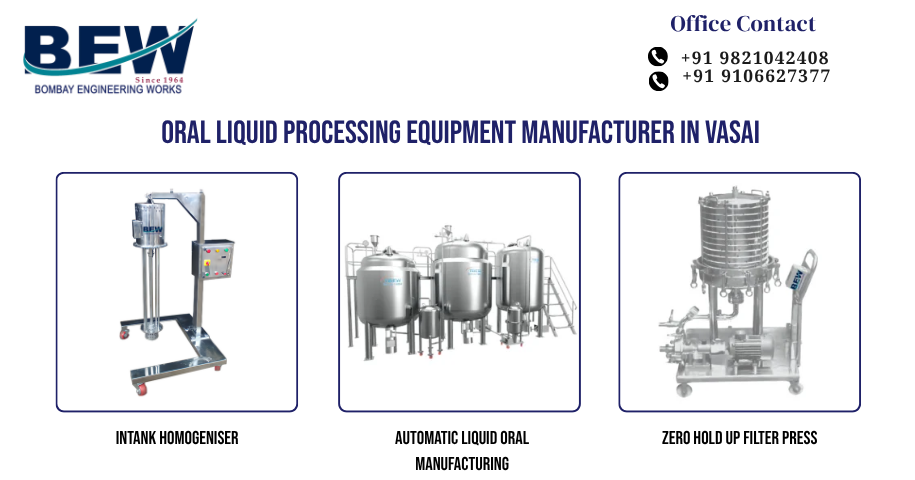
3. Homogenizer
Some formulations require intensive mixing. A homogenizer can provide fine dispersion, emulsion formation, and improved uniformity for selected cosmetic, pharmaceutical, and specialty liquid products.
4. Storage Tank
Storage tanks hold finished or semi-finished products before filling. They may include agitators, level indicators, temperature monitoring, cleaning systems, and heating or cooling provisions. Gentle agitation may be required for products that settle or separate.
5. Transfer Pump
A transfer pump moves liquid between processing stages, such as:
Manufacturing Vessel → Storage Tank → Filling Machine
Selection should consider viscosity, flow rate, temperature, pressure, material compatibility, and hygienic requirements.
6. Filtration System
Filtration may be used to remove unwanted particles or undissolved material. The system should be selected according to product characteristics, required filtration level, flow rate, batch size, temperature, and viscosity.
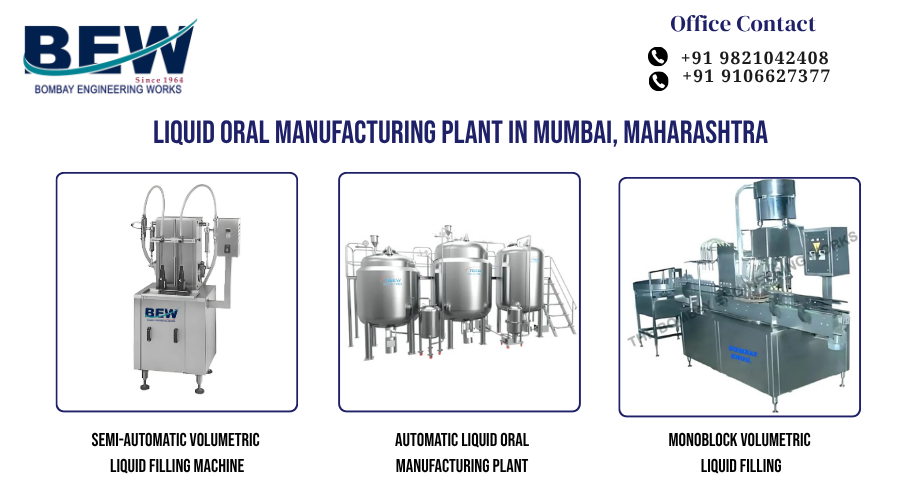
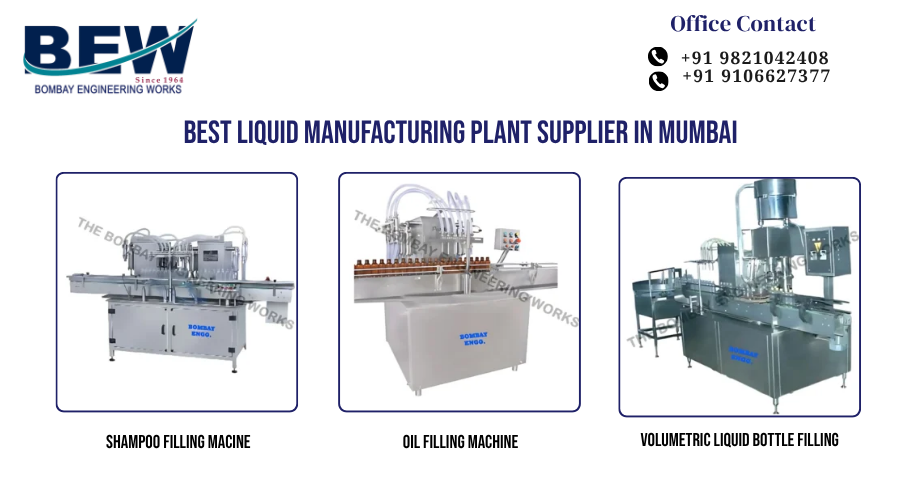
7. Liquid Filling Machine
Once manufactured, the product is transferred to a filling machine for packaging. Filling equipment can be selected for different container types and volumes. Accurate filling helps reduce product wastage, packaging issues, and production costs while supporting future expansion.
How Does a Small Scale Liquid Manufacturing Plant Work?
A complete plant may include several interconnected machines, depending on the product and manufacturing process.
The typical liquid manufacturing workflow can include:
- Raw Material Preparation: Raw materials are received, checked, weighed, and prepared according to the manufacturing formula.
- Charging: Ingredients are added to the manufacturing vessel in the required sequence, depending on temperature and mixing requirements.
- Mixing: The agitator blends the ingredients to achieve the required uniformity while protecting sensitive components.
- Heating or Cooling: The product may be heated to dissolve ingredients or cooled before further processing, depending on the formulation.
- Homogenization: Homogenization may be used where intensive dispersion or emulsification is required.
- Filtration: Where necessary, the product is filtered to remove unwanted particles and achieve the required cleanliness.
- Storage: The finished product may be transferred to a storage vessel before filling.
- Filling and Packaging: The liquid is filled into bottles, containers, jars, pouches, or other suitable packaging.
Benefits of Setting Up a Small-Scale Liquid Manufacturing Plant in India
A small-scale production system helps manufacturers start at a manageable capacity with flexibility for future growth.
Flexible Production and Product Development
Small-scale plants support manageable batch sizes, multiple formulations, and product development.
- Flexible batch production
- Formulation testing and sampling
- Easier market evaluation
Better Production Control
A properly designed plant allows manufacturers to monitor key parameters and maintain better process control.
- Temperature and mixing speed
- Batch quantity and processing time
- Product transfer and filling volume
Scalable Manufacturing
A small plant can be expanded as demand increases through additional vessels, larger capacities, automation, or filling equipment.
Suitable for Multiple Industries
The basic plant concept can be adapted for pharmaceutical, cosmetic, chemical, herbal, and food-related applications, depending on process and material requirements.
Small-Scale Liquid Manufacturing Plants for Different Industries
Liquid manufacturing plants can be configured for different industries according to the product, batch size, formulation, and process requirements.
Pharmaceutical & Cosmetic Applications
Pharmaceutical plants may produce syrups, oral liquids, suspensions, and solutions, while cosmetic plants can handle shampoos, lotions, creams, gels, and cleansers.
- Manufacturing and mixing vessels
- Storage and filtration systems
- Homogenization and transfer equipment
- Filling and process-control systems
Equipment selection should consider hygiene, cleanability, material compatibility, viscosity, and process requirements.
Chemical & Specialty Applications
Small-scale plants can process liquid chemicals, solutions, and specialty formulations. Equipment must be selected according to chemical compatibility and operating conditions.
- Chemical composition and concentration
- Temperature and viscosity
- Corrosion and material compatibility
- Agitation and safety requirements
Ayurvedic, Herbal & Food Applications
Plants can also be configured for herbal syrups, extracts, oils, liquid preparations, and food or beverage products. The system may include mixing, heating, filtration, storage, transfer, and filling equipment.
The final configuration should be based on the ingredients, product characteristics, hygiene requirements, and production capacity.
Why Choose Bombay Engineering Works for a Small Scale Liquid Manufacturing Plant?
Bombay Engineering Works can assist businesses looking for machinery solutions based on factors such as batch capacity, product characteristics, mixing requirements, heating or cooling requirements, and production objectives.
Rather than treating every requirement as a standard machine purchase, manufacturers can discuss their process requirements and develop an equipment configuration suitable for their application.
This multi-industry experience can be valuable because liquid processing requirements often overlap across different manufacturing sectors.
Established in 1964, the company has built experience across several machinery segments, including:
- Pharmaceutical Machinery
- Chemical Machinery
- Food Processing Machinery
- Cosmetic Machinery
- Ayurvedic Machinery
- Herbal Machinery
Bombay Engineering Works brings decades of engineering experience to industrial machinery manufacturing.
E-E-A-T (Experience Expertise Authoritativeness Trustworthiness)
Experience
Bombay Engineering Works has been established since 1964 and has experience across pharmaceutical, chemical, food processing, cosmetic, Ayurvedic, and herbal machinery.
Expertise
The content explains practical machinery considerations including vessel capacity, agitator selection, viscosity, homogenization, filtration, heating/cooling, transfer, storage, and filling.
Authoritativeness
The page positions Bombay Engineering Works around its long-standing machinery manufacturing experience rather than making unsupported performance claims
Trustworthiness
Product suitability, machinery configuration, pricing, and regulatory considerations are presented as application-dependent instead of promising one universal solution.
Frequently Asked Questions (FAQs)
Q1. What is a small scale liquid manufacturing plant?
Ans: A small-scale liquid manufacturing plant is a compact industrial setup used to manufacture liquid products in controlled batches. It can include manufacturing vessels, mixers, homogenizers, storage tanks, pumps, filtration systems, and filling machines depending on the product.
Q2. Which industries use small scale liquid manufacturing plants?
Ans: Pharmaceutical, cosmetic, chemical, food processing, Ayurvedic, herbal, personal care, and specialty product manufacturers can use small-scale liquid manufacturing systems.
Q3. Can a small liquid manufacturing plant be customized?
Ans: Yes. Equipment can be designed according to factors such as batch capacity, product viscosity, mixing requirements, heating or cooling needs, material compatibility, automation, and filling requirements.
Q4. How do I choose the correct mixing system?
Ans: The mixing system should be selected based on product viscosity, batch size, density, solids content, desired mixing time, shear requirement, and formulation characteristics.
Q5. Can the plant be expanded in the future?
Ans: Yes. A plant can often be planned with future expansion in mind by allowing space and utilities for additional vessels, larger equipment, or additional filling capacity.
Contact Bombay Engineering Works Today
Address: Unit No. 9, Unity Industrial Estate, Naikpada, Valiv Village, Near Ganesh Mandir, Vasai East, Dist: Palghar-401208.
Phone: +91 9821042408 / +91 9106627377
Email: info@bombayengg.com / admin@bombayengg.com / support@bombayengg.com
Website: www.bombayengg.com
Conclusion
A Small Scale Liquid Manufacturing Plant India offers businesses a flexible solution for producing pharmaceutical, cosmetic, chemical, food, Ayurvedic, and herbal liquids efficiently. Selecting suitable vessels, mixers, pumps, homogenizers, storage tanks, and filling equipment helps achieve consistent production while supporting future business expansion.
For a reliable Small Scale Liquid Manufacturing Plant India, choosing an experienced machinery manufacturer is essential. Since 1964, Bombay Engineering Works has provided machinery solutions across multiple industries, helping manufacturers select equipment according to batch size, product characteristics, processing requirements, and production objectives.
Call Bombay Engineering Works today: 9821042408
Visit: www.bombayengg.com
“Don’t forget to share this post!”