Ointment Plant Supplier in Mumbai

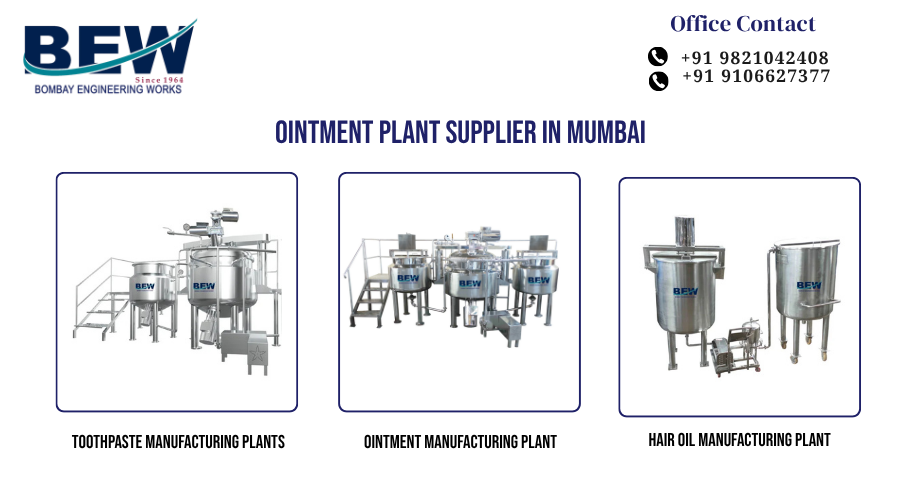




Ointment Plant Supplier in Mumbai – Pharmaceutical Ointment Manufacturing Equipment
If you are looking for a reliable Ointment Plant Supplier in Mumbai, choosing the right machinery partner is an important decision for pharmaceutical, cosmetic, Ayurvedic, herbal, and personal-care manufacturing operations. An ointment manufacturing plant must provide controlled mixing, heating, emulsification, homogenization, vacuum processing, and hygienic transfer while maintaining consistency from one batch to another.
Bombay Engineering Works is an established manufacturer and supplier of pharmaceutical, chemical, food processing, cosmetic, Ayurvedic, and herbal machinery. Established in 1964, the company brings decades of engineering and manufacturing experience to industrial equipment requirements.
Call us today: 9821042408
Website: www.bombayengg.com
About Bombay Engineering Works
Bombay Engineering Works, established in 1964, is a manufacturer and supplier of industrial machinery serving a wide range of manufacturing sectors. With decades of experience in engineering and machinery manufacturing, the company provides equipment solutions for Pharmaceutical, Chemical, Food, Cosmetic, Ayurvedic, and Herbal industries.
The company focuses on developing machinery according to specific product characteristics, manufacturing processes, production capacities, and batch-size requirements.
Its engineering approach emphasizes:
- Precision-oriented machinery design
- Hygienic and practical equipment construction
- Durable industrial components
- Consistent processing performance
- Suitable batch capacities
- Product-specific engineering considerations
- Practical solutions for modern manufacturing facilities
- Machinery selection assistance
- Manufacturing and supply support
For manufacturers evaluating an Ointment Plant Supplier in Mumbai, this experience is particularly relevant because ointment production can involve multiple processing stages. The equipment needs to work together as a coordinated production system rather than simply functioning as individual machines. For enquiries regarding ointment manufacturing machinery and plant requirements, contact Bombay Engineering Works at 9821042408.
What Is an Ointment Manufacturing Plant?
An ointment manufacturing plant is an integrated production system designed to manufacture semi-solid pharmaceutical, cosmetic, Ayurvedic, herbal, and related products.
Depending on the formulation, the process can include:
- Raw material preparation
- Oil-phase preparation
- Water-phase preparation
- Heating
- Mixing
- Emulsification
- Homogenization
- Vacuum processing
- Cooling
- Final blending
- Filtration, where applicable
- Transfer to filling equipment
- Packaging
The precise process depends on the formulation and required product characteristics. For example, a pharmaceutical ointment may require controlled processing conditions that differ from those used for a cosmetic cream. Similarly, herbal and Ayurvedic formulations may have specific raw material and processing considerations.
Therefore, an ointment plant should ideally be designed around the actual product and manufacturing process, rather than selecting equipment solely on the basis of nominal capacity.
Why Choosing the Right Ointment Plant Supplier Matters
The supplier you select can influence several aspects of your manufacturing operation, including equipment performance, process consistency, maintenance requirements, production efficiency, and future scalability.
A reliable supplier should understand more than fabrication. The supplier should be able to understand the relationship between:
Product formulation → Process requirements → Equipment configuration → Production capacity → Hygiene → Quality → Scalability
This is especially important when manufacturing products with different viscosities, solids content, emulsification requirements, or temperature sensitivities.
An experienced Ointment Plant Supplier in Mumbai can help manufacturers evaluate questions such as:
- What batch capacity is required?
- Is vacuum processing necessary?
- What type of agitator is suitable?
- Is homogenization required?
- What heating and cooling arrangement is appropriate?
- What product-contact material should be considered?
- How should the equipment be cleaned?
- How should the finished product be transferred?
- What level of automation is appropriate?
- How can future capacity expansion be accommodated?
These considerations can have a significant impact on the long-term usefulness of the plant.
What Equipment Is Included in an Ointment Manufacturing Plant?
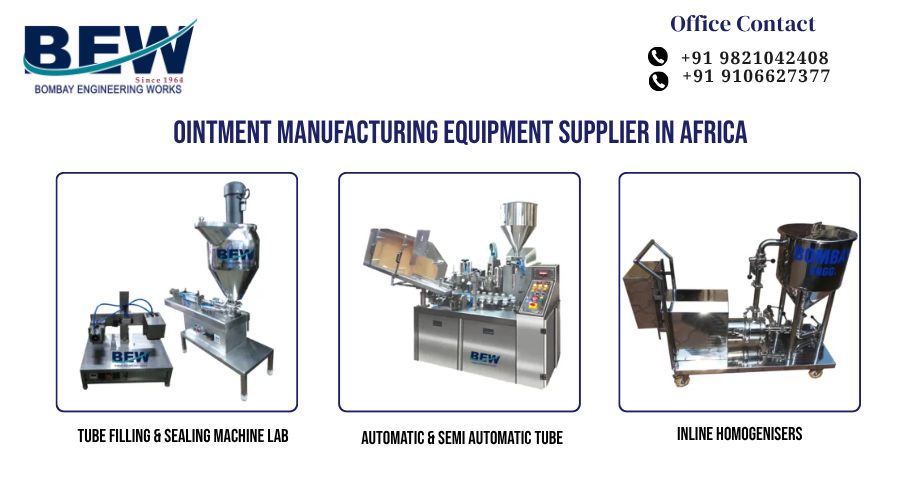
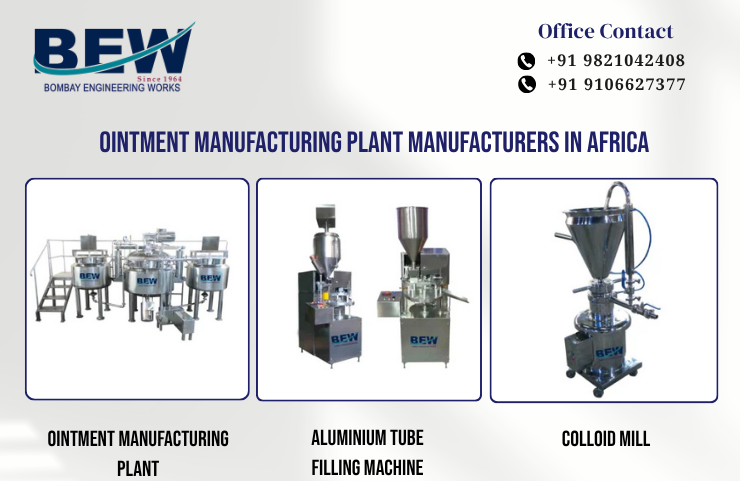
An ointment manufacturing plant typically consists of interconnected equipment designed for mixing, heating, cooling, homogenization, storage, and product transfer. The exact configuration depends on the formulation, batch size, viscosity, and production requirements.
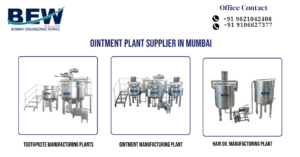
1. Manufacturing Vessel with Agitator
The manufacturing vessel is the central equipment where ingredients are mixed and processed. It may include heating and cooling provisions, temperature monitoring, an agitator, vacuum capability, and hygienic process connections.
The agitator promotes uniform mixing throughout the batch. Its design should be selected according to product viscosity, batch size, formulation characteristics, mixing requirements, and desired processing time.
2. Homogenizer and Vacuum System
A homogenizer provides controlled high-shear processing for formulations that require fine dispersion or emulsification. The vacuum system can help reduce entrapped air and support controlled processing where required.
Both systems should be selected according to the formulation and desired product characteristics rather than being treated as standard requirements for every ointment.
3. Heating and Cooling System
Controlled heating may be required for melting waxes, preparing oil phases, softening fatty ingredients, and supporting emulsification. After processing, controlled cooling helps achieve the required viscosity, texture, stability, and consistency.
The heating and cooling arrangement should provide uniform temperature control while considering the product’s temperature sensitivity.
4. Holding Vessel and Transfer System
A holding vessel can temporarily store the processed ointment before filling or further processing. It may include agitation, temperature control, level monitoring, and hygienic connections.
The transfer system moves the product between different stages of production. Depending on product viscosity and plant design, it may include suitable pumps, pipelines, valves, and sanitary fittings.
Overall, the equipment configuration should be customized according to the formulation, production capacity, batch size, and specific manufacturing process.
How Does an Ointment Manufacturing Plant Work?
Although the exact process varies according to the formulation, an ointment manufacturing process generally involves raw material preparation, controlled mixing, heating, homogenization, cooling, and transfer to filling.
Raw Material and Phase Preparation
Raw materials are received, checked, weighed, and prepared according to the formulation. Where required, oil-soluble and water-soluble ingredients may be prepared separately before being combined.
Heating, Mixing and Homogenization
Waxes, fatty materials, and other ingredients may be heated to the required processing temperature before mixing. The prepared ingredients are then combined in the manufacturing vessel using suitable agitation. For emulsion-based formulations, controlled emulsification may be carried out, followed by homogenization where required to improve product uniformity.
Vacuum Processing, Cooling and Transfer
Where required, vacuum processing can help reduce entrapped air. The product is then gradually cooled under controlled conditions, with final mixing performed as necessary to maintain uniformity. The finished ointment is transferred to a holding vessel or filling machine for packaging.
Applications of Ointment Manufacturing Plants
Ointment manufacturing systems can be used across several industries.
Pharmaceutical Industry
Pharmaceutical ointment plants can be used for manufacturing various semi-solid topical formulations.
Depending on the formulation and manufacturing requirements, applications may include products designed for:
- Dermatological applications
- Topical formulations
- Protective preparations
- Therapeutic preparations
- Semi-solid pharmaceutical products
Pharmaceutical manufacturing requires careful attention to hygiene, process control, material compatibility, and batch consistency.
Cosmetic Industry
The same basic processing principles can also apply to cosmetic products such as:
- Creams
- Balms
- Skin-care formulations
- Moisturizing products
- Protective creams
- Hair and scalp preparations
- Personal-care products
Cosmetic products can have highly specific texture and consistency requirements, making appropriate mixing and homogenization important.
Ayurvedic and Herbal Industry
Ointment and semi-solid manufacturing systems can also support Ayurvedic and herbal product manufacturing.
Depending on the formulation, manufacturers may process:
- Herbal ointments
- Herbal balms
- Ayurvedic creams
- Plant-based topical preparations
- Traditional semi-solid formulations
The processing approach should be developed according to the raw materials and formulation characteristics.
Key Factors to Consider When Selecting an Ointment Plant
Choosing an ointment manufacturing plant requires a structured evaluation based on production and process requirements.
Production Capacity and Product Characteristics
Plant capacity and product properties directly influence equipment selection. Consider:
- Required batch size and annual production
- Product viscosity and mixing requirements
- Future production expansion plans
Heating, Cooling and Homogenization
The thermal and mixing systems should match the formulation requirements. Key factors include:
- Required processing temperature
- Heating and cooling requirements
- Homogenization requirements
Vacuum and Material of Construction
Vacuum capability and product-contact materials should be selected according to the actual process. Consider:
- Whether vacuum processing is required
- Compatibility with product ingredients
- Hygiene and process requirements
Cleaning and Maintenance
The plant should allow practical cleaning, inspection, and servicing. Manufacturers should consider:
- Accessibility of product-contact areas
- Ease of cleaning and inspection
- Routine maintenance requirements
Although the exact process varies according to the formulation, an ointment manufacturing process generally involves raw material preparation, controlled mixing, heating, homogenization, cooling, and transfer to filling.
Maintenance of an Ointment Manufacturing Plant
Regular maintenance helps preserve equipment performance.
A maintenance program may include:
- Inspection of agitators
- Checking mechanical seals
- Inspecting valves and fittings
- Checking pumps
- Monitoring heating systems
- Inspecting cooling arrangements
- Checking vacuum components
- Lubricating appropriate mechanical components
- Inspecting electrical and control systems
- Cleaning product-contact areas
The exact maintenance schedule should be determined according to the machinery design and operating conditions. Preventive maintenance can also help identify potential issues before they develop into major operational problems.
Ointment Plant for Small, Medium and Large Production
Different manufacturers have different production requirements.
Small-Batch Manufacturing
Small production facilities may prioritize:
- Compact equipment
- Flexible batch sizes
- Easy operation
- Lower initial investment
- Product development flexibility
Medium-Scale Manufacturing
Medium-sized manufacturers may require:
- Higher batch capacities
- Improved process automation
- Faster transfer
- Multiple product capabilities
- Better production scheduling
Large-Scale Manufacturing
Large production operations may require:
- High-capacity manufacturing vessels
- Multiple processing vessels
- Automated controls
- Integrated transfer systems
- Dedicated holding vessels
- Higher throughput
- Production scalability
Therefore, the correct plant capacity should be determined using realistic production calculations.
E-E-A-T (Experience Expertise Authoritativeness Trustworthiness)
Experience
Bombay Engineering Works was established in 1964, representing decades of engineering and manufacturing experience.
Expertise
The company works across pharmaceutical, chemical, food, cosmetic, Ayurvedic, and herbal machinery requirements, allowing it to address diverse manufacturing applications.
Authoritativeness
Long-term participation in industrial machinery manufacturing helps establish practical knowledge of equipment design and manufacturing requirements.
Trustworthiness
Transparent discussions about capacity, process requirements, equipment configuration, and application-specific needs can help customers make informed machinery decisions.
Frequently Asked Questions (FAQs)
Q1. What is an ointment manufacturing plant?
Ans: An ointment manufacturing plant is a collection of process equipment used to manufacture semi-solid products such as pharmaceutical ointments, creams, balms, cosmetic preparations, and selected Ayurvedic or herbal formulations.
Q2. Who needs an ointment manufacturing plant?
Ans: Pharmaceutical companies, cosmetic manufacturers, Ayurvedic manufacturers, herbal product companies, and other businesses producing suitable semi-solid formulations may require ointment manufacturing equipment.
Q3. How do I choose an Ointment Plant Supplier in Mumbai?
Ans: Evaluate the supplier based on engineering experience, machinery manufacturing capabilities, product understanding, customization, capacity options, technical support, equipment quality, and suitability for your specific manufacturing process.
Q4. Is vacuum necessary in an ointment manufacturing plant?
Ans: An ointment manufacturing plant is a collection of process equipment used to manufacture semi-solid products such as pharmaceutical ointments, creams, balms, cosmetic preparations, and selected Ayurvedic or herbal formulations.
Q5. What capacity ointment plant should I purchase?
Ans: The appropriate capacity depends on batch size, production targets, number of batches, product portfolio, and future expansion plans. Capacity should be calculated before equipment selection.
Contact Bombay Engineering Works Today
Address: Unit No. 9, Unity Industrial Estate, Naikpada, Valiv Village, Near Ganesh Mandir, Vasai East, Dist: Palghar-401208.
Phone: +91 9821042408 / +91 9106627377
Email: info@bombayengg.com / admin@bombayengg.com / support@bombayengg.com
Website: www.bombayengg.com
Conclusion
Selecting an Ointment Plant Supplier in Mumbai is an important step for any company planning to manufacture pharmaceutical, cosmetic, Ayurvedic, herbal, or related semi-solid products. A successful plant requires more than a manufacturing vessel. The complete process may involve controlled heating, cooling, mixing, homogenization, vacuum processing, transfer, holding, and filling. Therefore, equipment should be evaluated as an integrated manufacturing solution.
With its establishment dating back to 1964, Bombay Engineering Works brings decades of engineering and manufacturing experience to machinery requirements across pharmaceutical, chemical, food, cosmetic, Ayurvedic, and herbal industries.
Call Bombay Engineering Works today: 9821042408
Visit: www.bombayengg.com
“Don’t forget to share this post!”