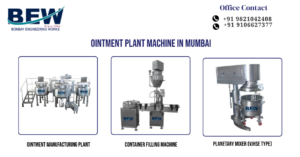
Ointment Plant Machine in Mumbai





Ointment Plant Machine in Mumbai | Complete Guide to Efficient, Hygienic & Reliable Ointment Manufacturing
If you are planning to establish or upgrade a pharmaceutical, cosmetic, Ayurvedic, or herbal production facility, choosing the right Ointment Plant Machine in Mumbai can make a significant difference to product quality, manufacturing consistency, hygiene, productivity, and long-term operating efficiency. Trust Bombay Engineering Works for reliable equipment and industry expertise to support your production goals.
Bombay Engineering Works has been serving the machinery industry since 1964 and manufactures equipment for pharmaceutical, chemical, food processing, cosmetic, Ayurvedic, and herbal applications. The company states that it manufactures more than 80 types of machinery and has supplied machinery to customers in India and international markets.
Call us today: 9821042408
Website: www.bombayengg.com
What Is an Ointment Plant Machine?
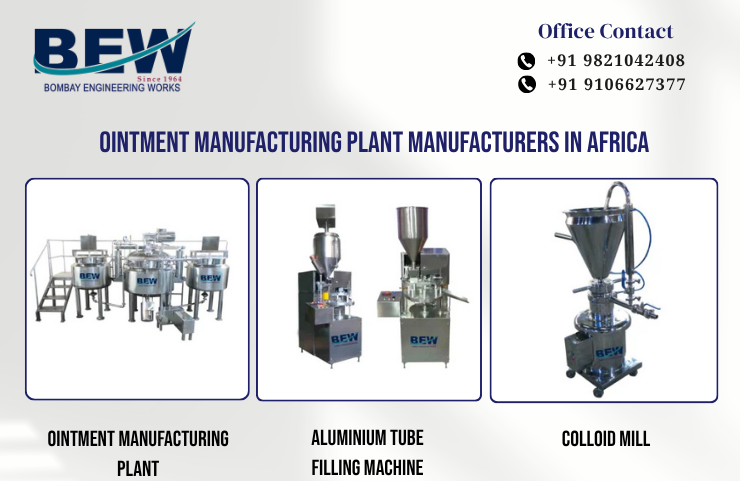
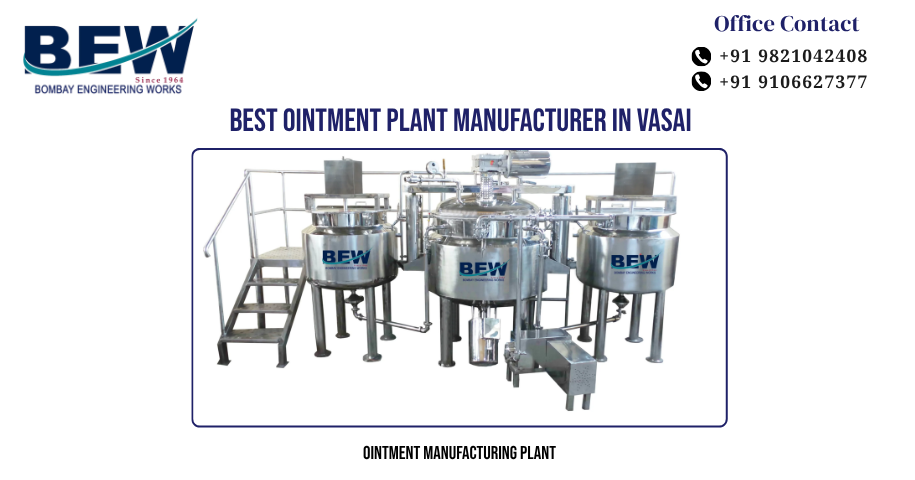
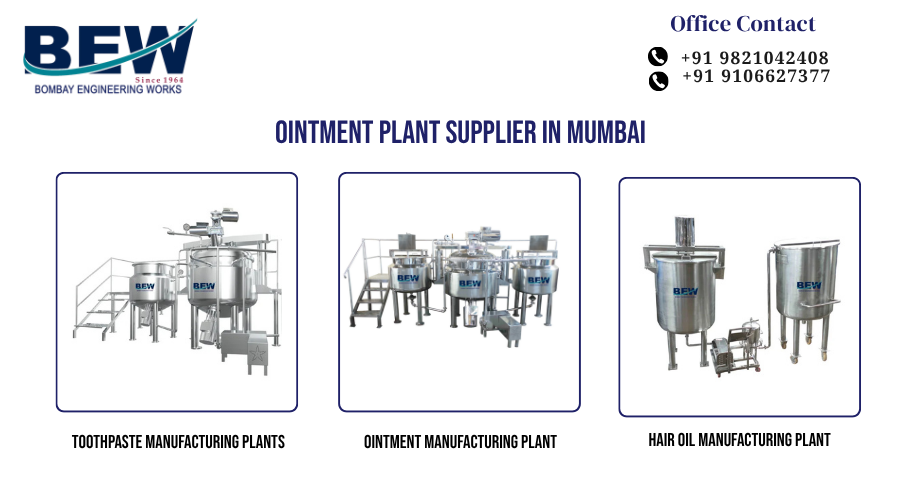
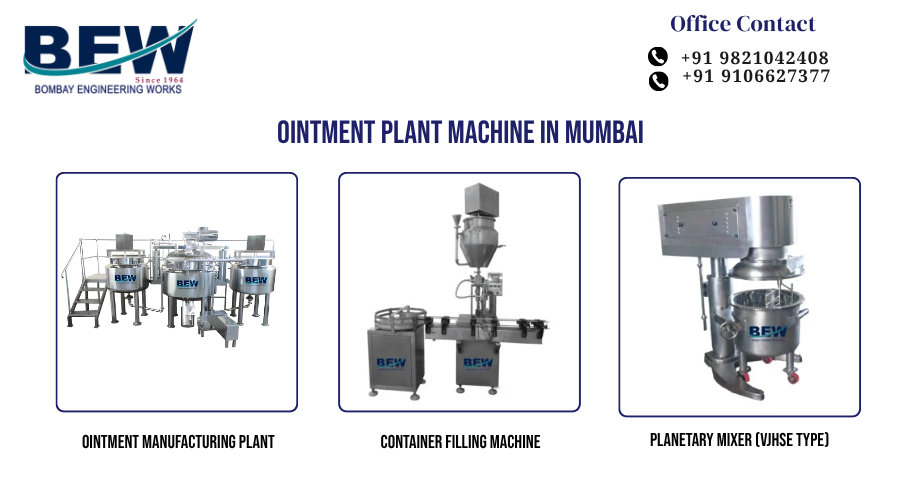
An ointment plant machine is part of an integrated manufacturing system used to produce pharmaceutical, cosmetic, Ayurvedic, and herbal semi-solid products. Depending on the formulation and production requirements, the system can incorporate manufacturing vessels, mixing arrangements, homogenizers, heating and cooling systems, vacuum arrangements, filtration systems, storage vessels, transfer systems, and filling equipment.
For example, a typical ointment manufacturing process may involve:
- Preparation of the aqueous phase
- Preparation of the oil or wax phase
- Heating of ingredients
- Controlled mixing
- Emulsification
- Homogenization
- Vacuum processing
- Cooling
- Filtration where required
- Transfer to storage or filling equipment
- Filling and packaging
Consequently, the design of the plant should be based on the formulation, batch size, viscosity, processing temperature, production volume, and desired automation level.
Why Is an Ointment Plant Important for Pharmaceutical Manufacturing?
Ointment production may appear straightforward, but achieving consistent quality at commercial scale requires careful control of several process variables.
An appropriately designed ointment plant can help manufacturers achieve:
- Uniform product consistency
- Controlled heating and cooling
- Efficient mixing
- Improved homogenization
- Reduced contamination risks
- Controlled vacuum processing
- Better batch repeatability
- Reduced manual intervention
- Improved production efficiency
- Easier cleaning and maintenance
- Scalable production
Moreover, modern manufacturing facilities increasingly look for equipment that supports hygienic processing and controlled operations. Therefore, selecting the right machinery partner becomes an important part of plant planning.
Ointment Plant Machine for Different Production Requirements
A small formulation company may need a compact batch-processing system, while a large pharmaceutical manufacturer may require higher-capacity vessels, increased automation, integrated transfer systems, and additional production controls.
Therefore, plant selection should consider:
- Required batch size
- Daily production target
- Number of products manufactured
- Product viscosity
- Heating requirements
- Cooling requirements
- Homogenization requirements
- Vacuum requirements
- Automation level
- Available floor space
- Cleaning requirements
- Future expansion plans
A well-planned system can therefore provide flexibility while avoiding unnecessary equipment costs.
Key Features of an Ointment Plant Machine
A modern ointment plant can incorporate several engineering features depending on the selected configuration.
1. Stainless Steel Product Contact Parts
Stainless steel construction can provide a hygienic and durable surface when appropriately designed, fabricated, finished, and maintained. For suitable applications, SS316 contact parts can be specified as part of the plant configuration.
2. Vacuum Processing
Vacuum processing can be useful in ointment manufacturing for reducing entrapped air and supporting controlled processing.
3. Heating and Cooling System
Ingredients may need to be heated during preparation and subsequently cooled under controlled conditions. Triple-jacketed vessels can be configured for heating and cooling applications, depending on the process design.
4. Homogenization
The ointment plant listed by Bombay Engineering Works offers specially designed bottom-entry or inline homogenizer configurations, including two-stage and four-stage options.
5. Sanitary Fittings and Valves
Sanitary-design fittings and valves can help support hygienic processing and simplify appropriate cleaning procedures.
6. PLC-Based Controls
Bombay Engineering Works lists PLC-based control panels with 21 CFR compliance as an available feature for its ointment manufacturing plant.
How Does an Ointment Manufacturing Plant Work?
The exact process varies according to the formulation. Nevertheless, a general ointment manufacturing workflow can include several stages.
Step 1: Raw Material Preparation
The manufacturing process begins with the preparation and weighing of ingredients according to the approved formulation and batch requirements.
Step 2: Phase Preparation
The ingredients are prepared in suitable vessels under controlled conditions. Depending on the formulation, heating may be required to melt waxes, fats, or other ingredients.
Step 3: Heating
Controlled heating allows suitable ingredients to reach the required processing temperature.
Step 4: Mixing
The prepared ingredients are combined and mixed according to the formulation’s processing requirements.
Step 5: Homogenization
Homogenization can help produce a more uniform formulation by reducing variations within the mixture.
Step 6: Vacuum Processing
The vacuum level and process conditions should be established according to the formulation and validated manufacturing process.
Step 7: Cooling
Controlled cooling can be important because temperature changes may affect viscosity, texture, stability, and final product characteristics.
Applications of Ointment Plant Machines
An Ointment Plant Machine in Mumbai can be used across multiple industries.
Pharmaceutical Industry
Pharmaceutical manufacturers use ointment plants for the production of topical formulations such as creams, ointments, gels, and other semi-solid preparations.
Cosmetic Industry
Cosmetic manufacturers may use similar processing systems for creams, lotions, gels, and other personal-care formulations.
Ayurvedic & Herbal Industry
Ayurvedic and herbal manufacturers can require specialized processing conditions for herbal creams, balms, ointments, and therapeutic formulations.
Personal Care Products
Manufacturers of topical personal-care products can also benefit from controlled mixing, heating, cooling, and homogenization systems.
GMP Considerations for Ointment Manufacturing
A GMP-oriented manufacturing environment focuses on consistent product quality, controlled processes, hygienic equipment, appropriate documentation, and reduced contamination risks.
For an ointment plant, important considerations may include:
- Appropriate material of construction
- Hygienic equipment design
- Suitable product-contact surfaces
- Controlled processing
- Temperature monitoring
- Appropriate vacuum systems
- Sanitary valves and fittings
- Cleaning procedures
- Controlled product transfer
- Process documentation
- Suitable automation and monitoring
The exact regulatory requirements depend on the product, market, facility, and applicable regulations. Therefore, manufacturers should ensure that their plant design and validation strategy is reviewed by appropriately qualified regulatory and engineering professionals.
Ointment Plant Machine in Mumbai for Startups and Established Manufacturers
Both new and established manufacturers can benefit from appropriately designed ointment manufacturing systems.
For startups, the focus may be on:
- Practical investment
- Suitable batch capacity
- Production flexibility
- Easy operation
- Future scalability
- Technical guidance
For established manufacturers, priorities may include:
- Higher production capacity
- Automation
- Process integration
- Consistent batch output
- Reduced manual intervention
- Advanced monitoring
- Expansion capabilities
Therefore, the ideal configuration should be based on the manufacturer’s current production requirements and long-term business strategy.
E-E-A-T: Experience, Expertise, Authoritativeness, Trustworthiness
Experience
Established in 1964, Bombay Engineering Works brings more than six decades of experience in manufacturing and supplying pharmaceutical, chemical, cosmetic, food processing, Ayurvedic, and herbal machinery.
Expertise
The company applies practical engineering knowledge to develop machinery solutions based on production capacity, formulation requirements, processing conditions, automation, and industry-specific needs.
Authoritativeness
With a broad machinery portfolio and experience serving diverse industrial applications, Bombay Engineering Works has established a strong presence in the industrial machinery sector.
Trustworthiness
Bombay Engineering Works focuses on quality engineering, reliable machinery, customized solutions, technical assistance, and after-sales support to build long-term customer relationships.
Frequently Asked Questions (FAQs)
Q1. What is an Ointment Plant Machine in Mumbai?
Ans: An Ointment Plant Machine in Mumbai is industrial equipment used to manufacture pharmaceutical, cosmetic, Ayurvedic, and herbal ointments, creams, gels, and other semi-solid products.
Q2. What industries use ointment manufacturing plants?
Ans: Pharmaceutical, cosmetic, Ayurvedic, herbal, personal-care, and related manufacturing industries can use ointment plants for suitable semi-solid formulations.
Q3. Can an ointment plant be customized?
Ans: Yes, an ointment manufacturing plant can be configured according to batch capacity, formulation characteristics, heating, cooling, homogenization, vacuum, and automation requirements.
Q4. Why choose Bombay Engineering Works for an ointment plant?
Ans: Bombay Engineering Works has been established since 1964 and offers pharmaceutical, cosmetic, chemical, food processing, Ayurvedic, and herbal machinery with customized engineering solutions.
Q5. Which industries use ointment manufacturing equipment?
Ans: Ointment plants are widely used in pharmaceutical, cosmetic, Ayurvedic, and herbal industries for manufacturing creams, ointments, gels, balms, and topical formulations.
Looking for a reliable Ointment Plant Machine in Mumbai? Connect with Bombay Engineering Works for quality pharmaceutical machinery and customized solutions.
Contact Bombay Engineering Works Today
Address: Unit No. 9, Unity Industrial Estate, Naikpada, Valiv Village, Near Ganesh Mandir, Vasai East, Dist: Palghar-401208.
Phone: +91 9821042408 / +91 9106627377
Email: info@bombayengg.com / admin@bombayengg.com / support@bombayengg.com
Website: www.bombayengg.com
Conclusion
Choosing the right Ointment Plant Machine in Mumbai can help manufacturers achieve efficient processing, consistent batches, hygienic production, and better operational control. The ideal machinery should be selected according to formulation, production capacity, process requirements, and future expansion needs.
With its experience since 1964 and expertise across pharmaceutical, chemical, cosmetic, food processing, Ayurvedic, and herbal machinery, Bombay Engineering Works provides dependable and application-focused machinery solutions for different manufacturing requirements.
Call Bombay Engineering Works today: 9821042408
Visit: www.bombayengg.com
“Don’t forget to share this post!”