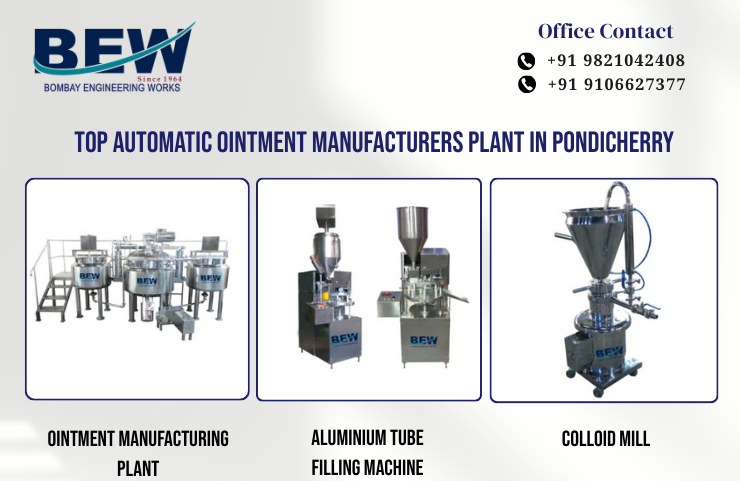
Ointment Manufacturing Plant Manufacturers in Mumbai

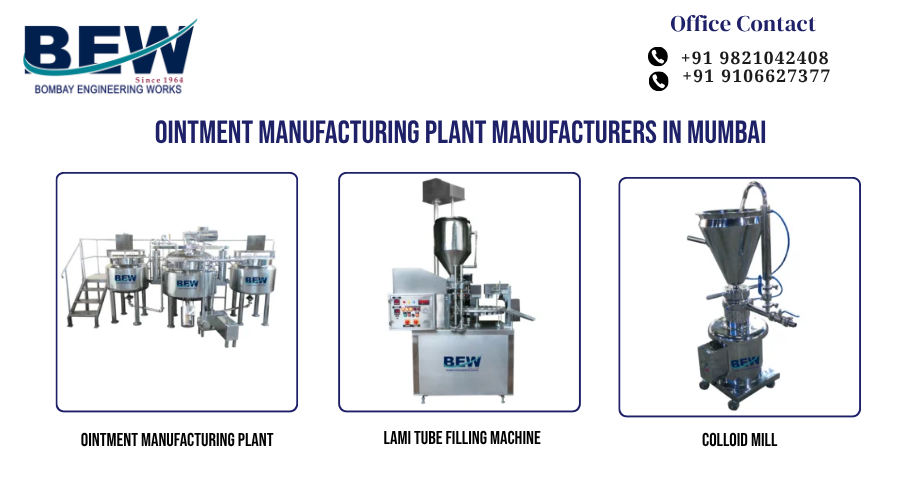




Ointment Manufacturing Plant Manufacturers in Mumbai
When pharmaceutical, cosmetic, Ayurvedic, or herbal companies plan to manufacture creams, ointments, gels, and other semi-solid formulations, choosing the right production equipment is an important business decision. A reliable Ointment Manufacturing Plant Manufacturers in Mumbai can help companies achieve consistent product quality, hygienic processing, efficient production, and scalable operations.
Bombay Engineering Works, established in 1964, has developed extensive experience in manufacturing and supplying pharmaceutical, chemical, food processing, cosmetic, Ayurvedic, and herbal machinery. The company manufactures more than 80 types of machinery and has installed more than 1,500 machines worldwide, serving customers across multiple countries.
Call us today: 9821042408
Website: www.bombayengg.com
Bombay Engineering Works: Experience Since 1964
Bombay Engineering Works has been serving industrial and pharmaceutical machinery requirements since 1964. The company originally started with Tray Dryers and, after 14 years, began marketing machinery under its own brand. Over time, its product portfolio expanded to more than 80 types of machines for pharmaceutical, chemical, food, cosmetic, Ayurvedic, and herbal industries.
Today, the company operates as a manufacturer and exporter of industrial machinery, with installations across India and international markets.
Its major product categories include:
- Pharmaceutical Machinery
- Chemical Machinery
- Food Processing Machinery
- Cosmetic Machinery
- Ayurvedic & Herbal Machinery
This broad engineering experience is valuable because ointment production frequently involves multiple interconnected systems rather than one standalone machine.
What Is an Ointment Manufacturing Plant?
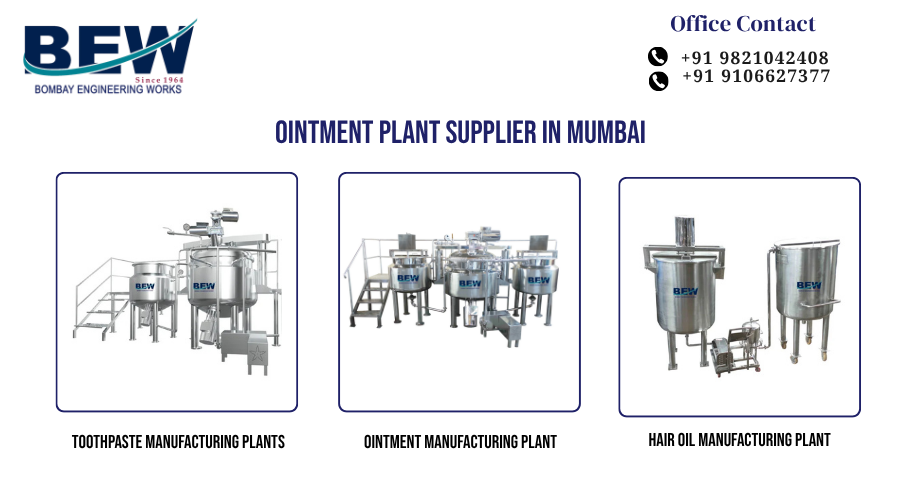
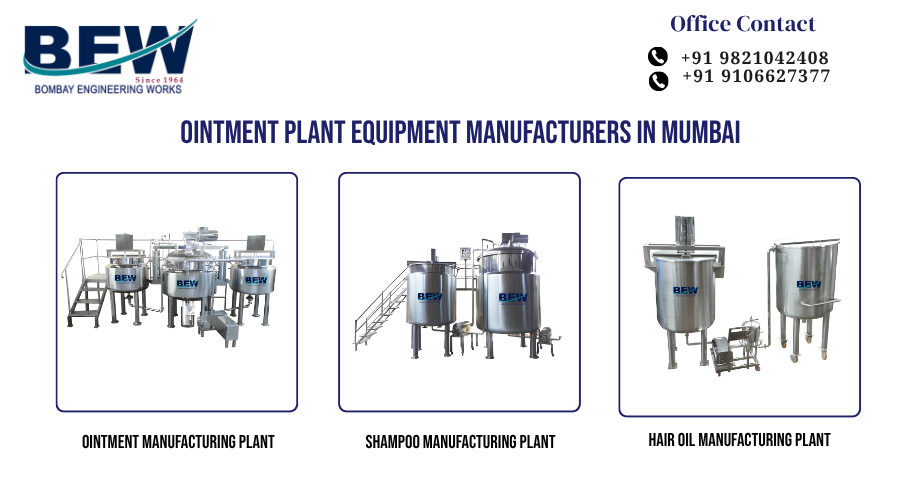
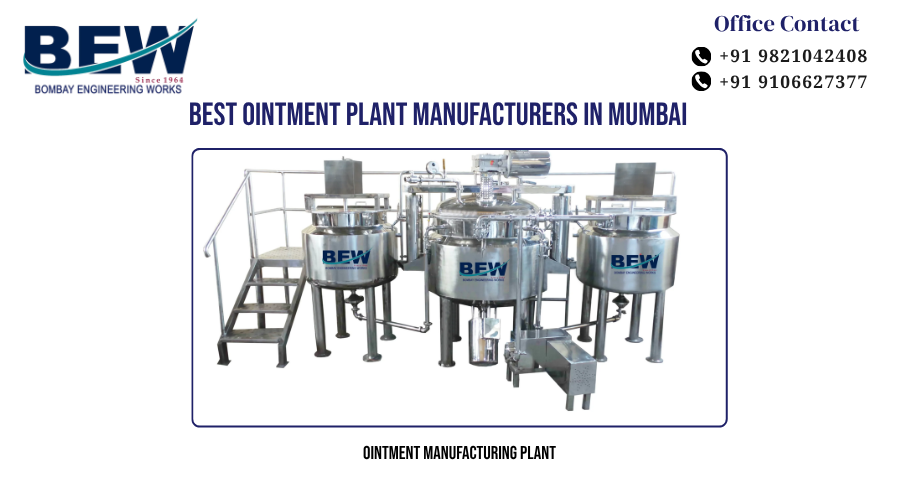
An ointment manufacturing plant is an integrated processing system used to manufacture semi-solid products such as pharmaceutical ointments, creams, gels, balms, cosmetic formulations, and selected Ayurvedic or herbal preparations.
The manufacturing process generally involves controlled heating, melting, mixing, emulsification, homogenization, cooling, and transfer. Depending on the formulation, the plant may also incorporate vacuum processing and filtration.
The objective is simple: produce a uniform, stable, hygienic, and repeatable formulation while maintaining process control throughout production.
For pharmaceutical manufacturers, the equipment must therefore be designed with appropriate material selection, sanitary construction, process control, and cleaning requirements in mind.
Why Choosing the Right Ointment Plant Manufacturer Matters
Not every manufacturing plant is designed for the same formulation or production scale. Therefore, selecting an experienced manufacturer is essential.
A well-engineered ointment manufacturing plant can help with:
- Consistent mixing and homogenization
- Controlled heating and cooling
- Reduced manual intervention
- Hygienic processing
- Improved batch-to-batch consistency
- Better process monitoring
- Efficient material transfer
- Flexible production requirements
- Easier integration of automation
Moreover, an experienced manufacturer can understand the relationship between the formulation, vessel design, agitator, homogenizer, vacuum system, heating arrangement, cooling system, and control panel.
That engineering understanding is particularly important when a company is setting up a new production facility or upgrading an existing plant.
Ointment Manufacturing Plant Features
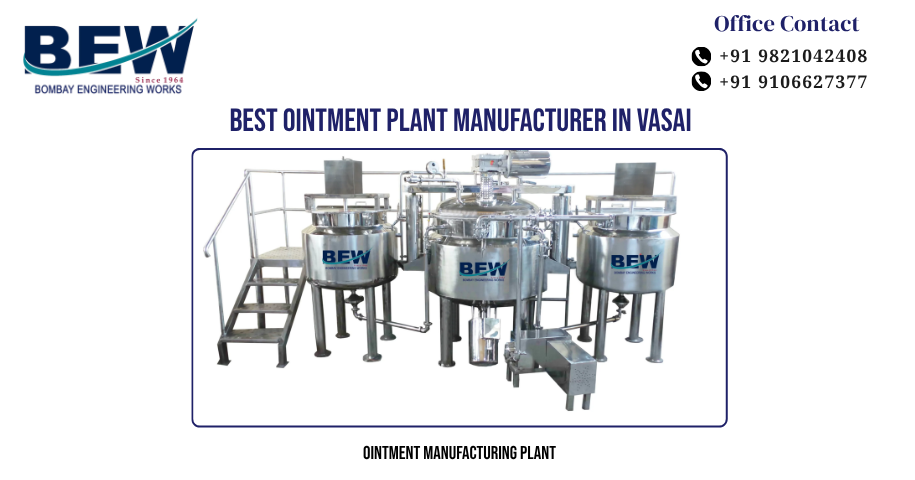
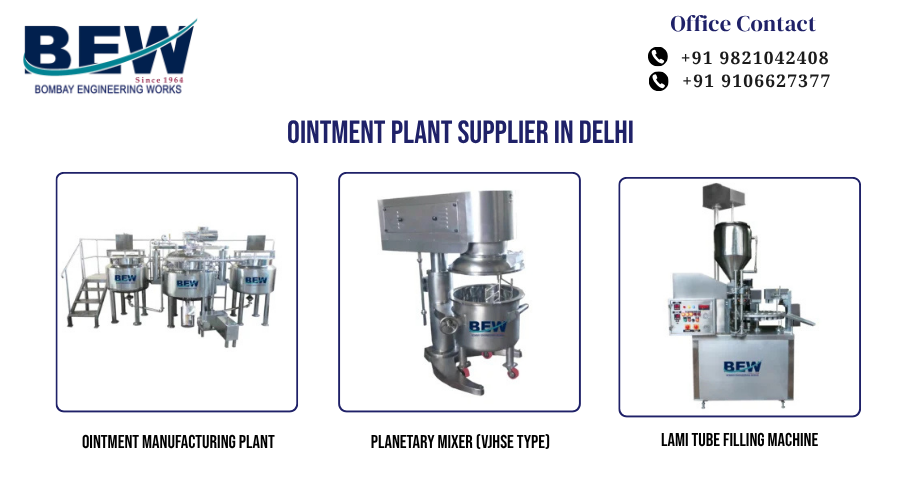
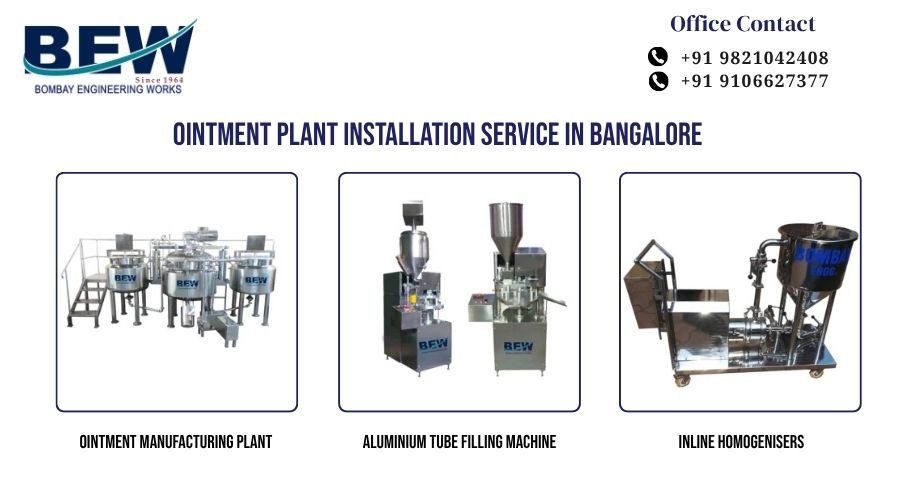
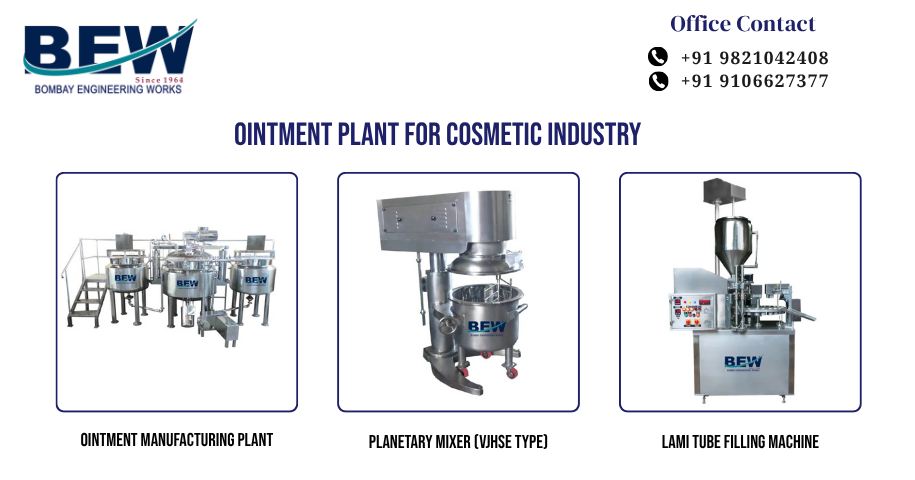
Bombay Engineering Works’ ointment manufacturing plant is designed with several process-oriented features. According to the company’s product information, the plant can incorporate a cGMP model with SS316 contact parts, fully automatic processing, vacuum processing, triple-jacketed vessels for heating and cooling, sanitary fittings and valves, online filtration arrangements, different agitator configurations, hydraulic top-dish lifting, and PLC-based controls.
Key features can include:
1. Stainless Steel Contact Parts
The continuous movement of particles through the drying air can provide effective heat and mass transfer.
2. Vacuum Processing
The process can be conducted under full vacuum. Vacuum processing can be useful for reducing air incorporation and supporting controlled processing of suitable formulations.
3. Heating and Cooling
Triple-jacketed vessels provide an arrangement for controlled heating and cooling. This is important because different formulation stages may require different temperature conditions.
4. Advanced Homogenization
The plant can be equipped with specially designed two-stage or four-stage bottom-entry homogenizers or inline homogenizers, depending on the process requirement.
Homogenization helps create a more uniform product by reducing particle or droplet size and promoting consistent dispersion.
5. Sanitary Fittings and Valves
Sanitary-design fittings and valves support hygienic processing and can simplify cleaning and maintenance.
6. PLC-Based Control
A PLC-based control panel can provide centralized process control and monitoring. The company’s product specifications also mention a 21 CFR-compliant control option.
7. Electropolished Pipeline
Electropolished pipelines can provide a smoother internal surface, which is particularly relevant where hygienic processing and cleanability are important considerations.
8. Load Cell and Automatic Valve Options
Depending on the project, load-cell integration and automatic valves can be considered for improved process control and automation.
How Does an Ointment Manufacturing Plant Work?
Although the exact process depends on the formulation, a typical ointment manufacturing operation may involve several stages.
Step 1: Preparation of Ingredients
Raw materials are weighed and prepared according to the formulation and manufacturing procedure.
Step 2: Heating and Melting
Suitable ingredients may be heated in dedicated vessels to achieve the required melting or preparation conditions.
Step 3: Mixing
Agitation helps combine ingredients and maintain a relatively uniform mixture.
Step 4: Emulsification and Homogenization
Where required, homogenization reduces particle or droplet size and supports uniform distribution throughout the formulation.
Step 5: Vacuum Processing
The formulation can be cooled under controlled conditions to achieve the required consistency and product characteristics.
Step 6: Cooling
Vacuum processing can assist in controlling entrapped air and maintaining the desired process environment.
Step 7: Transfer and Filling
Once the batch reaches the required condition, it can be transferred toward storage or filling equipment.
This integrated approach helps manufacturers move from raw material preparation to finished-product handling with better process control.
Applications of Ointment Manufacturing Plants
Ointment plants are not limited to one pharmaceutical product category. Depending on the design and formulation, they can support manufacturing requirements across several industries.
Pharmaceutical Industry
Applications may include:
- Medicinal ointments
- Dermatological formulations
- Topical creams
- Gels
- Antibiotic formulations
- Other semi-solid pharmaceutical products
Cosmetic Industry
Cosmetic manufacturers may use similar processing systems for:
- Skin creams
- Moisturizing formulations
- Cosmetic gels
- Beauty creams
- Specialty topical products
Bombay Engineering Works also lists ointment manufacturing equipment within its cosmetic machinery portfolio.
Ayurvedic & Herbal Industry
Ointment manufacturing systems can also be adapted for selected Ayurvedic and herbal formulations, including topical preparations and herbal balms.
Ointment Plant Equipment and Supporting Machinery
A complete ointment production line may involve several pieces of equipment depending on the formulation and production requirements.
These may include:
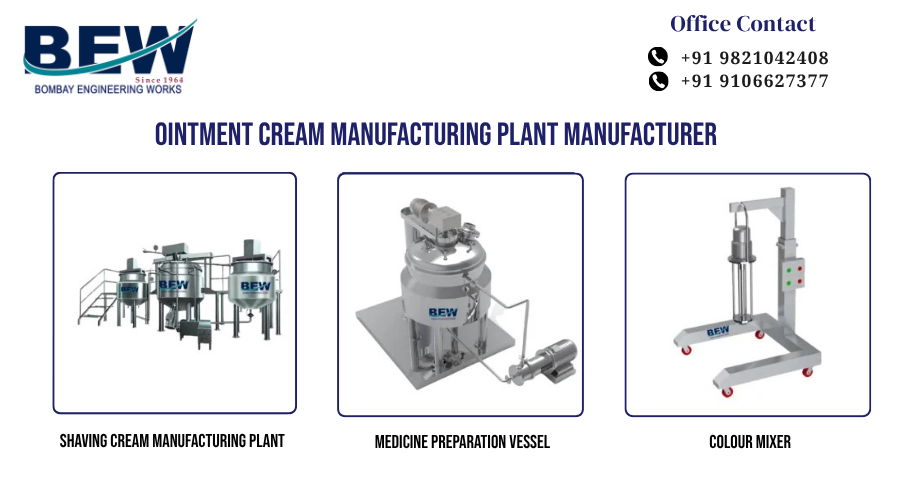
- Manufacturing vessels
- Storage vessels
- Agitators
- Homogenizers
- Vacuum systems
- Transfer pumps
- Filters
- Heating and cooling systems
- Control panels
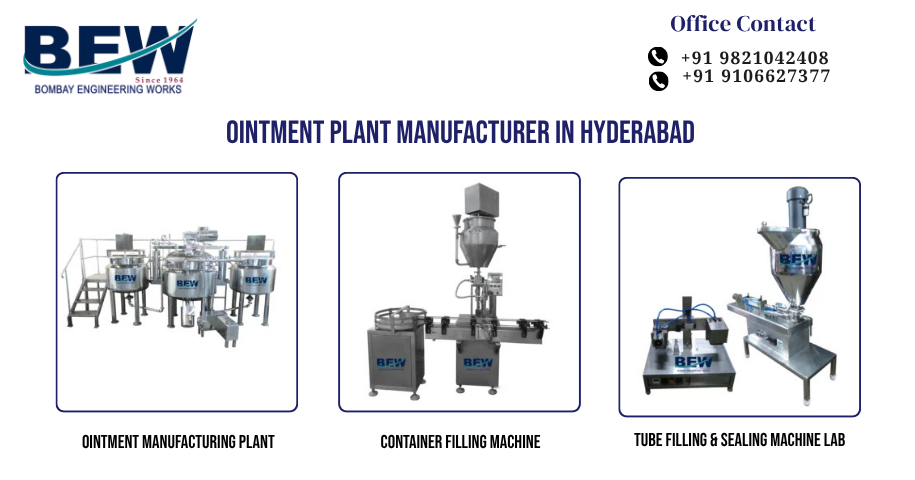
- Tube filling machines
- Tube sealing equipment
Bombay Engineering Works’ pharmaceutical machinery portfolio includes an Ointment Section along with tablet, capsule, liquid, injectable, dry syrup, soft gel, and utility sections
The company also manufactures tube-filling machinery suitable for products such as creams, ointments, gels, pastes, and balms.
Why Bombay Engineering Works Can Be a Reliable Choice
When evaluating Ointment Manufacturing Plant Manufacturers in Mumbai, businesses should consider experience, engineering capabilities, manufacturing quality, customization, technical support, and after-sales service not simply the initial machine price.
Bombay Engineering Works brings several decades of industry experience along with a broad machinery portfolio.
More Than Six Decades of Experience
Established in 1964, the company’s long operating history demonstrates sustained involvement in industrial machinery manufacturing.
Wide Machinery Expertise
Because the company works across pharmaceutical, chemical, food, cosmetic, Ayurvedic, and herbal machinery, it can approach projects from a broader process-engineering perspective.
Large Installation Base
The company’s website reports more than 1,500 machines installed worldwide, reflecting its experience with industrial machinery projects.
Bombay Engineering Works has developed an international customer base and exports its machinery to global markets.
Export Experience
Ointment production requirements can differ significantly between manufacturers. Therefore, plant design can be considered according to capacity, formulation, automation, material requirements, and process configuration.
Custom Engineering
E-E-A-T: Why Experience and Engineering Expertise Matter
Experience
Bombay Engineering Works has been operating since 1964 and has expanded from Tray Dryers into a broad range of industrial machinery.
Expertise
The company manufactures pharmaceutical, chemical, food processing, cosmetic, Ayurvedic, and herbal machinery, giving it extensive cross-industry engineering exposure.
Authoritativeness
More than 1,500 machines installed worldwide and a portfolio of over 80 machinery types demonstrate an established industrial presence.
Trustworthiness
Product information, company history, manufacturing capabilities, factory details, and contact information are publicly presented through the company’s official website.
Frequently Asked Questions (FAQs)
Q1. What is an ointment manufacturing plant?
Ans: An ointment manufacturing plant is an integrated processing system used to manufacture semi-solid products such as ointments, creams, gels, and selected cosmetic or herbal formulations.
Q2. Who are the Ointment Manufacturing Plant Manufacturers in Mumbai?
Ans: Bombay Engineering Works is an established manufacturer and supplier of pharmaceutical and allied machinery, with experience dating back to 1964. The company manufactures ointment manufacturing plants and related pharmaceutical machinery.
Q3. What materials are commonly used for ointment plant contact parts?
Ans: For pharmaceutical applications, stainless steel such as SS316 is commonly selected for suitable product-contact components. Bombay Engineering Works specifies SS316 contact parts for its cGMP ointment manufacturing plant model.
Q4. Why is homogenization important in ointment manufacturing?
Ans: Homogenization helps achieve a more uniform dispersion and consistency by reducing particle or droplet size and improving mixing characteristics.
Q5. Can an ointment manufacturing plant be customized?
Ans: Yes. Plant configuration can be developed according to factors such as production capacity, formulation characteristics, heating and cooling requirements, homogenization method, automation level, and other project-specific requirements.
Contact Bombay Engineering Works Today
Address: Unit No. 9, Unity Industrial Estate, Naikpada, Valiv Village, Near Ganesh Mandir, Vasai East, Dist: Palghar-401208.
Phone: +91 9821042408 / +91 9106627377
Email: info@bombayengg.com / admin@bombayengg.com / support@bombayengg.com
Website: www.bombayengg.com
Conclusion
Choosing the right Ointment Manufacturing Plant Manufacturers in Mumbai is an important step for companies that want reliable, hygienic, efficient, and scalable semi-solid production. A successful project requires more than machinery alone; it requires appropriate process engineering, material selection, automation, homogenization, heating and cooling, vacuum processing, and technical coordination.
Whether you are establishing a new pharmaceutical production facility, expanding an existing plant, or looking for specialized ointment-processing equipment, Bombay Engineering Works can discuss your process requirements and help identify an appropriate engineering solution.
With a legacy dating back to 1964, more than 80 types of machinery, and over 1,500 machines installed worldwide, Bombay Engineering Works has built substantial experience in pharmaceutical and allied machinery manufacturing.
Call Bombay Engineering Works today: 9821042408
Visit: www.bombayengg.com
“Don’t forget to share this post!”