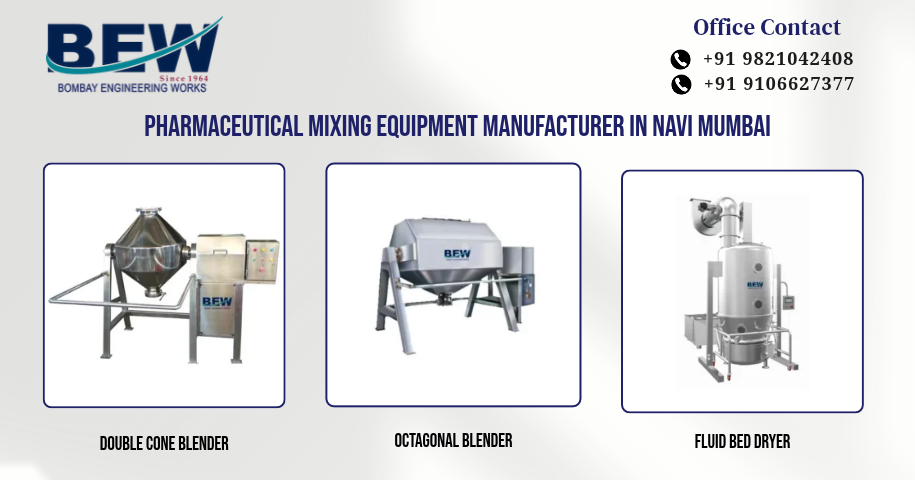
Pharmaceutical Mixing Equipment Manufacturer in Navi Mumbai





Pharmaceutical Mixing Equipment Manufacturer in Navi Mumbai | Bombay Engineering Works
Blending accuracy and hygienic engineering decide the final quality of every pharmaceutical formulation. Manufacturers searching for a dependable Pharmaceutical Mixing Equipment Manufacturer in Navi Mumbai need machinery that delivers repeatable homogenisation across every batch. Bombay Engineering Works has been building processing machinery since 1964 for plants across India.
The right mixing system depends on viscosity, batch volume, shear sensitivity, and cleaning protocol. Bombay Engineering Works supplies homogenisers, agitators, blenders, and stirrer assemblies configured around real production data rather than guesswork. Each unit is evaluated against the product profile and the downstream process it must feed.
A well-matched mixer shortens cycle times, protects sensitive actives, and simplifies sanitation between batches. Share your process details with the team and receive a specification matched to your line.
Call us today: 9821042408 Website: www.bombayengg.com
About Us
Founded in 1964, Bombay Engineering Works designs and builds process machinery for pharmaceutical, chemical, food, cosmetic, and herbal manufacturers. The company’s portfolio covers mixing, filtration, and material handling equipment built for continuous plant duty.
- Six decades of fabrication and process engineering knowledge.
- Mixer configurations matched to viscosity, batch size, and shear limits.
- Units built for straightforward cleaning and low maintenance downtime.
- Support across pharmaceuticals, chemicals, food, cosmetics, and Ayurvedic lines.
Every enquiry is reviewed against product behaviour, throughput targets, and sanitation routines before a machine is recommended. This practical approach keeps the equipment grounded in real operating conditions rather than catalogue assumptions.
Mixing Technology Explained for Process Engineers
A mixer must suit the material it handles. A shear-sensitive biological suspension behaves very differently from a high-solids powder blend or a viscous syrup base.
Unlike general-purpose agitators, pharmaceutical mixers are evaluated for cleanability, surface finish, drainability, and containment of potent ingredients.
Mixing machinery typically includes:
- Anchor and paddle agitators for low to medium viscosity liquids.
- High-shear homogenisers for dispersing and emulsifying formulations.
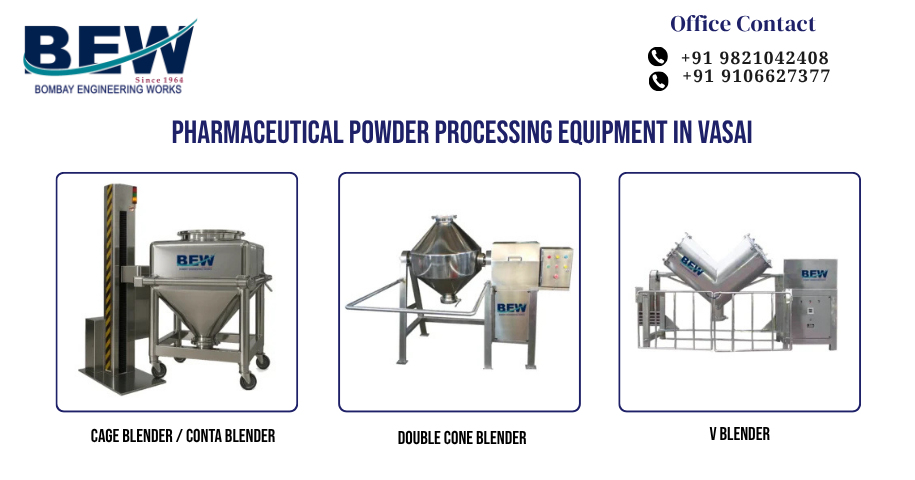
- Ribbon and double-cone blenders for dry powder and granule mixing.
- Planetary mixers for pastes, ointments, and gel-based products.
- Custom stirrer assemblies sized around the vessel and batch volume.
- Skid-mounted mixing stations configured for a specific production line.
No single impeller design handles every duty. A configuration that works for a thin oral solution will usually fail on a thick topical paste.
Why Controlled Mixing Decides Batch Quality
Mixing influences more than uniformity. It affects dissolution, stability, and how consistently the product performs after storage.
1. Uniform Active Distribution
An active ingredient must be distributed evenly through the carrier medium. Poor dispersion produces hotspots that fail content uniformity testing.
Proper impeller geometry and controlled speed profiles help achieve that uniformity without excessive shear.
2. Stable Emulsions and Suspensions
Liquid formulations often depend on stable dispersion of one phase in another. If the mix separates, the product fails visual and performance checks.
High-shear mixing helps produce and maintain those dispersions reliably across repeated batches.
3. Repeatable Cycle Times
A mixer that requires a different time for every batch disrupts scheduling and downstream operations. Consistent mixing performance keeps the entire line predictable.
The correct blade geometry, baffle arrangement, and speed control all contribute to predictable outcomes.
4. Reduced Product Loss
Vessels and impellers designed for full drainability reduce leftover material after discharge. This matters when the formulation uses costly actives or narrow batch margins.
Good drainage also shortens cleaning cycles between campaigns.
5. Cleanability Between Campaigns
Surfaces that contact product should be smooth, accessible, and compatible with the cleaning agents used at the facility. Poorly finished internals trap residue and create cross-contamination risk.
Design features that support verified cleaning are therefore as important as mixing performance itself.
Core Mixing Equipment Configurations
When shortlisting a Pharmaceutical Mixing Equipment Manufacturer in Navi Mumbai, process teams should compare how each design handles their specific material.
1. High-Shear Homogeniser
A high-shear homogeniser uses a rapidly rotating head to create intense local turbulence, breaking down agglomerates and forming fine dispersions or emulsions.
Common application considerations include:
- Emulsification of oil and water phases.
- Wet milling of suspended solids.
- Dissolving difficult powders into liquid bases.
- Stabilising formulations that would otherwise separate on standing.
Speed, head design, and processing time need to be balanced against the shear tolerance of the active ingredient.
2. Anchor and Paddle Agitators
Anchor and paddle agitators provide gentle bulk movement across the vessel. They are widely used where the product is viscous but should not be subjected to intense shear.
These designs are common in gel, ointment, and syrup production where gentle uniformity is the priority.
Potential considerations include:
- Vessel geometry and wall clearance.
- Blade width relative to vessel diameter.
- Speed range needed for the product’s viscosity.
- Bottom-scraping capability for heat-sensitive formulations.
A slightly oversized anchor may consume excess power without improving mixing quality. Matching the impeller to the vessel is more effective than simply increasing motor size.
3. Ribbon Blender
A ribbon blender uses helical ribbons within a horizontal trough to move powders and granules in opposing directions, producing a thorough blend without excessive heat.
These units are common in tablet and capsule preparation where dry uniformity is essential.
Typical evaluation points include:
- Bulk density and flow behaviour of the powders.
- Blend ratio and component particle sizes.
- Required uniformity and sampling method.
- Discharge arrangement and product recovery.
- Cleaning access for the trough and ribbons.
- Containment level needed for potent compounds.
Ribbon blenders are often favoured where rapid, uniform dry blending is required. The final specification should still reflect material testing and blend validation.
4. Planetary Mixer
Planetary mixers combine rotation and revolution to reach the entire vessel volume. They handle thick pastes, ointments, and gels that would defeat a conventional agitator.
Interchangeable blades and scraper arms allow one unit to serve multiple product types.
When selecting a planetary mixer, confirm that the discharge, tooling, and vessel finish suit the intended product contact requirements.
5. Inline and Continuous Mixers
Inline mixers blend material as it flows through a pipe, making them suitable for continuous processing and high-throughput lines.
Depending on the design, they support dilution, dispersion, and blending steps within a flowing product stream.
The selection process should consider flow rate, pressure drop, residence time, and cleanability between runs.
For continuous lines, mixing performance must be validated against the residence-time distribution and the required homogeneity of the finished stream.
Selection Criteria Every Buyer Should Verify
Choosing a mixing system requires clarity on the material, the target outcome, and the environment in which the machine will operate.
Before committing to a purchase, work through the following checks.
1. State the Mixing Goal Clearly
Start by describing exactly what the mixer must achieve.
Is the aim to blend dry powders, emulsify two liquids, disperse a solid into a base, or maintain a suspension throughout filling?
Different goals point to different impeller types and vessel geometries. Defining the outcome early avoids buying a machine that cannot deliver it.
2. Map the Material Behaviour
Material characteristics directly govern mixing performance.
Important characteristics include:
- Viscosity profile and whether it changes during mixing.
- Particle size, bulk density, and flow behaviour.
- Chemical compatibility with wetted materials.
- Temperature limits and heat sensitivity.
- Tendency to aerate or foam.
- Whether the ingredient is potent, hazardous, or oxygen-sensitive.
- Whether the material must be recovered or transferred without loss.
An impeller that works for a low-viscosity solution may stall or cavitate in a thick paste.
Suppliers therefore need representative process data before recommending a configuration.
3. Confirm Contact Materials and Finish
Product-contact surfaces must suit the formulation and the cleaning regime. Material grade and surface roughness both affect corrosion resistance and residue retention.
Depending on the application, this may involve stainless steel grades, specialised alloys, or specific elastomer seals.
Consider chemical exposure, cleaning agents, temperature cycling, and the required surface finish.
The most polished option is not always the right one. Over-specifying surface finish can add cost without improving process outcomes.
Sectors That Rely on Industrial Mixing Machinery
Mixing equipment serves many industries, each with its own material behaviour and hygiene expectations.
Tablet and Capsule Manufacturing
Dry blending precedes granulation and compression. Uniform distribution of the active and excipients at this stage affects weight variation and dissolution results.
Liquid Formulation and Syrups
Syrups and oral liquids demand complete dissolution of sugars and actives, often at elevated viscosity. Agitator and homogeniser combinations are commonly used to achieve clarity and stability.
Ointments, Creams, and Gels
Semi-solid products require uniform dispersion of actives in a cream or gel base. Planetary and high-shear mixers are typical choices for these viscous systems.
Ayurvedic and Herbal Preparations
Herbal pastes, churnas, and liquid extracts vary widely in consistency. Trials with representative batches help confirm that the mixer can handle natural variability.
Food and Cosmetic Processing
Equipment used in food and cosmetic plants must meet the hygiene and material standards of those sectors. A machine that suits one industry cannot automatically be assumed suitable for another.
How Mixing Quality Shapes the Finished Product
Mixing quality shapes product performance from the first production stage. Uniform blends deliver consistent assay results, while poor mixing shows up later as rejected batches and rework costs. Selecting equipment that suits the formulation helps protect both product quality and plant efficiency.
Key Benefits of Correctly Specified Mixing:
- Content Uniformity: Even distribution of actives across the batch.
- Stable Formulations: Emulsions and suspensions that remain intact through shelf life.
- Predictable Throughput: Cycle times that support production planning.
- Efficient Cleaning: Shorter changeover and sanitation windows.
- Reduced Rework: Fewer rejected batches due to inconsistent blending.
E-E-A-T (Experience, Expertise, Authoritativeness, Trustworthiness)
Experience
Operating since 1964, Bombay Engineering Works has supplied mixing and processing machinery to plants across India. Decades of shop-floor feedback inform how each unit is specified and built.
Expertise
The team works across pharmaceutical, chemical, food, cosmetic, and herbal production environments, adapting mixer configurations to each sector’s material behaviour.
Authoritativeness
A broad machinery portfolio and long-standing presence in the process equipment sector underpin the company’s standing among industrial buyers.
Trustworthiness
Detailed equipment specifications, responsive communication, and verifiable technical information allow buyers to evaluate options with confidence.
FAQ
Q1. What does a Pharmaceutical Mixing Equipment Manufacturer in Navi Mumbai supply?
Ans: Such a manufacturer supplies agitators, homogenisers, ribbon blenders, planetary mixers, and custom stirrer assemblies for pharmaceutical production. Bombay Engineering Works builds these units for batch and continuous lines. Buyers should confirm that the specific model suits their formulation and cleaning routine.
Q2. How do I know which mixer type fits my product?
Ans: Begin with the material’s viscosity, shear sensitivity, and target uniformity. Liquid formulations usually favour agitators or homogenisers, while dry powders need ribbon or double-cone blenders. Viscous pastes call for planetary designs. Sharing representative samples and process data with the supplier confirms the right configuration.
Q3. Can Bombay Engineering Works customise mixing equipment?
Ans: Yes. Bombay Engineering Works configures mixing machinery around vessel size, impeller geometry, and drive requirements. Contact the team with your batch volume and product details to confirm what can be adapted for your line.
Q4. What cleaning features should a pharmaceutical mixer have?
Ans: Product-contact surfaces should be smooth, accessible, and compatible with the facility’s cleaning agents. Drainable vessels, crevice-free welds, and easy tool removal all support effective cleaning between batches. Confirm these details against your sanitation protocol before ordering.
Q5. What information helps when requesting a mixing equipment quotation?
Ans: Provide the product type, batch volume, viscosity range, shear sensitivity, vessel dimensions, and cleaning requirements. Details on material of construction and installation space also help the supplier prepare an accurate proposal.
Contact Us
Address: Unit No. 9, Unity Industrial Estate, Naikpada, Valiv Village, Near Ganesh Mandir, Vasai East, Dist: Palghar-401208.
Phone: +91 9821042408 / +91 9106627377
Email: info@bombayengg.com / admin@bombayengg.com / support@bombayengg.com
Website: www.bombayengg.com
Conclusion
Choosing the right Pharmaceutical Mixing Equipment Manufacturer in Navi Mumbai shapes product uniformity, cycle times, and sanitation efficiency. The correct machine depends on formulation behaviour, batch size, and cleaning expectations. Bombay Engineering Works supports buyers in matching equipment to those requirements.
Since 1964, the company has supplied mixing and processing machinery to pharmaceutical and industrial plants. Buyers can review available configurations and request a specification aligned with their process.
Call Bombay Engg today: 9821042408
Visit: www.bombayengg.com